
Image: Peter Holderness for Caltech
by Sabrina Pirzada
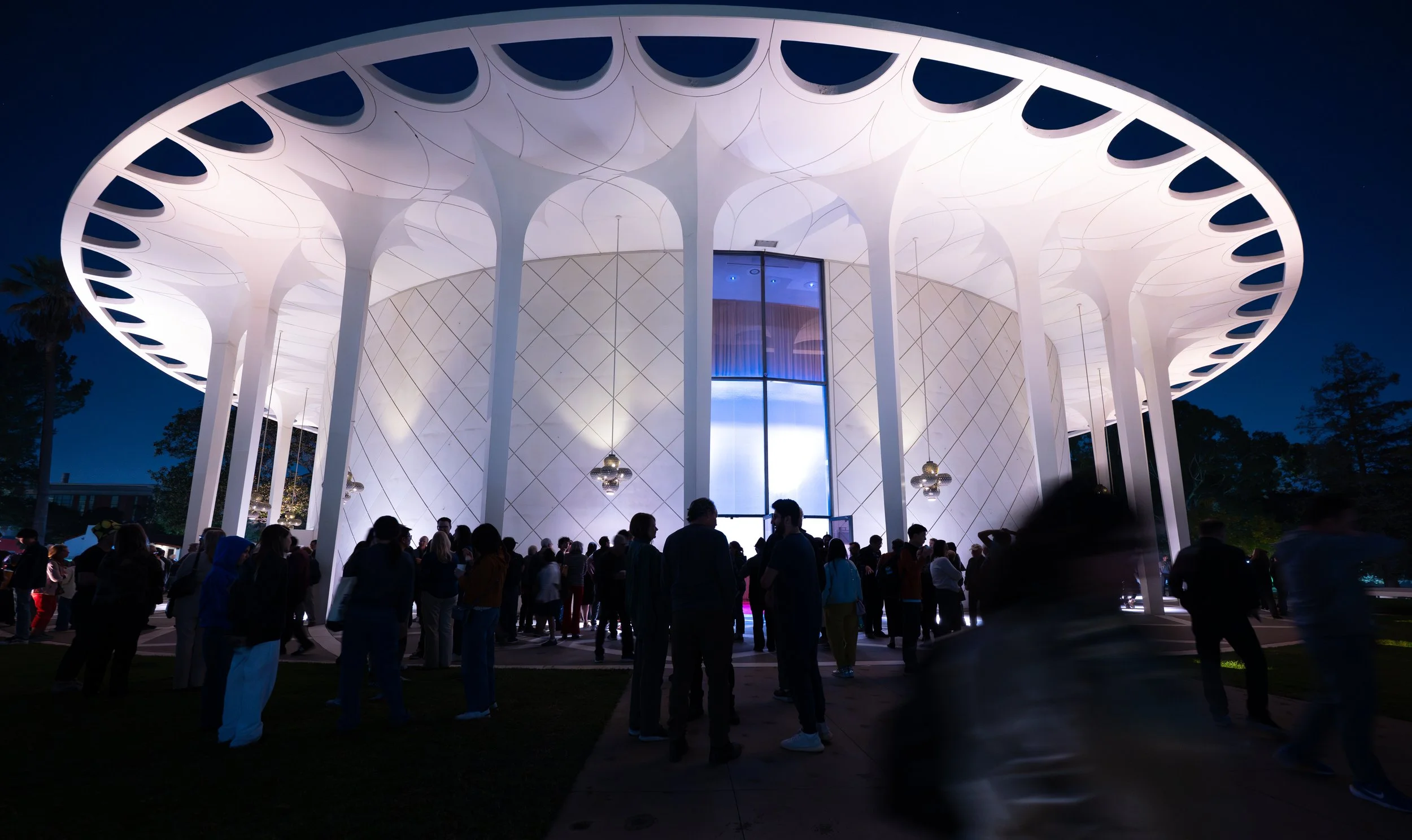
For more than 100 years, Caltech’s Earnest C. Watson Lecture Series has brought the wonder and excitement of groundbreaking research to the public through free live events designed to spark conversation and connection.
The 2025–26 season drew thousands of guests to Beckman Auditorium to hear directly from the scientists and engineers whose bold questions will become tomorrow’s world-changing discoveries and innovations. Their talks reflected a shared commitment to rigorous curiosity-driven science with an eye toward expanding knowledge and solving some of society’s most challenging problems.
Here are just some of the insights shared during the 103rd Watson season:
The Biggest Mystery in Physics Could Be Solved on a Tabletop
The universe should technically contain equal parts matter and antimatter, yet we live in a reality made almost entirely of matter. For the last century, high-energy particle accelerators were seen as the only way to investigate this mystery. Now, by using precision measurement techniques, like lasers, to control and manipulate molecules, scientists can search for mysterious forces through tabletop experiments. Nick Hutzler (BS ’07), professor of physics, is using this approach to probe the imbalance of matter and antimatter behind the formation of the universe.
Urban Wildfires Require a New Toolkit for Public Health Policy
Unlike traditional wildfires, urban wildfires, such as the Los Angeles fires of 2025, release toxic cocktails of legacy chemicals, lead, PFAS (forever plastics), and asbestos from materials that were used to build older homes. François Tissot, professor of geochemistry and Heritage Medical Research Institute Investigator, measured the invisible threat of lead and other toxic metals in the environment after the Eaton fire, pointing to an urgent need for insurance companies and government agencies to move beyond the “sight and smell” testing they rely on today. Quantitative data, such as testing the blood for heavy metals like lead, particularly for young children, is just one starting point to assess exposure and chart a path toward recovery.
A Martian Mountain Preserved the Story of a Once-Habitable Mars
Beyond the discovery of once-habitable conditions on Mars—including water sources, essential chemical elements, and the complex organic molecules that make up the building blocks of life—a key finding from the Curiosity mission is that the Red Planet provides a record of planetary-scale climate change. During the rover’s Martian odyssey, now 13 years and counting, Mars Science Laboratory project scientist Ashwin Vasavada (PhD ’98) learned how Mars transitioned from a habitable world with millions of years of persistent lakes to a dry, frozen desert. This work painted an important picture of the long-term stability of planetary environments and the conditions that allow life to persist over eons.
Rethinking the Fundamental Chemistry in Batteries Could Lead to More Sustainable Energy
Next-generation batteries will play a pivotal role in meeting the energy needs of the future while reducing dependence on fossil fuels. Current battery technologies come with significant challenges. They rely on scarce and expensive materials that are limited in their effectiveness because they can only store electrons in metal atoms. A different approach, called anion redox, recruits the electrons in surrounding atoms as additional storage. This increases the number of places available within a battery to hold charge. Kimberly See, professor of chemistry, is building iron-sulfur batteries using this principle that can reach energy densities that rival or exceed current high-end lithium-ion batteries. Plus, iron and sulfur are far more abundant and less environmentally fraught to source.
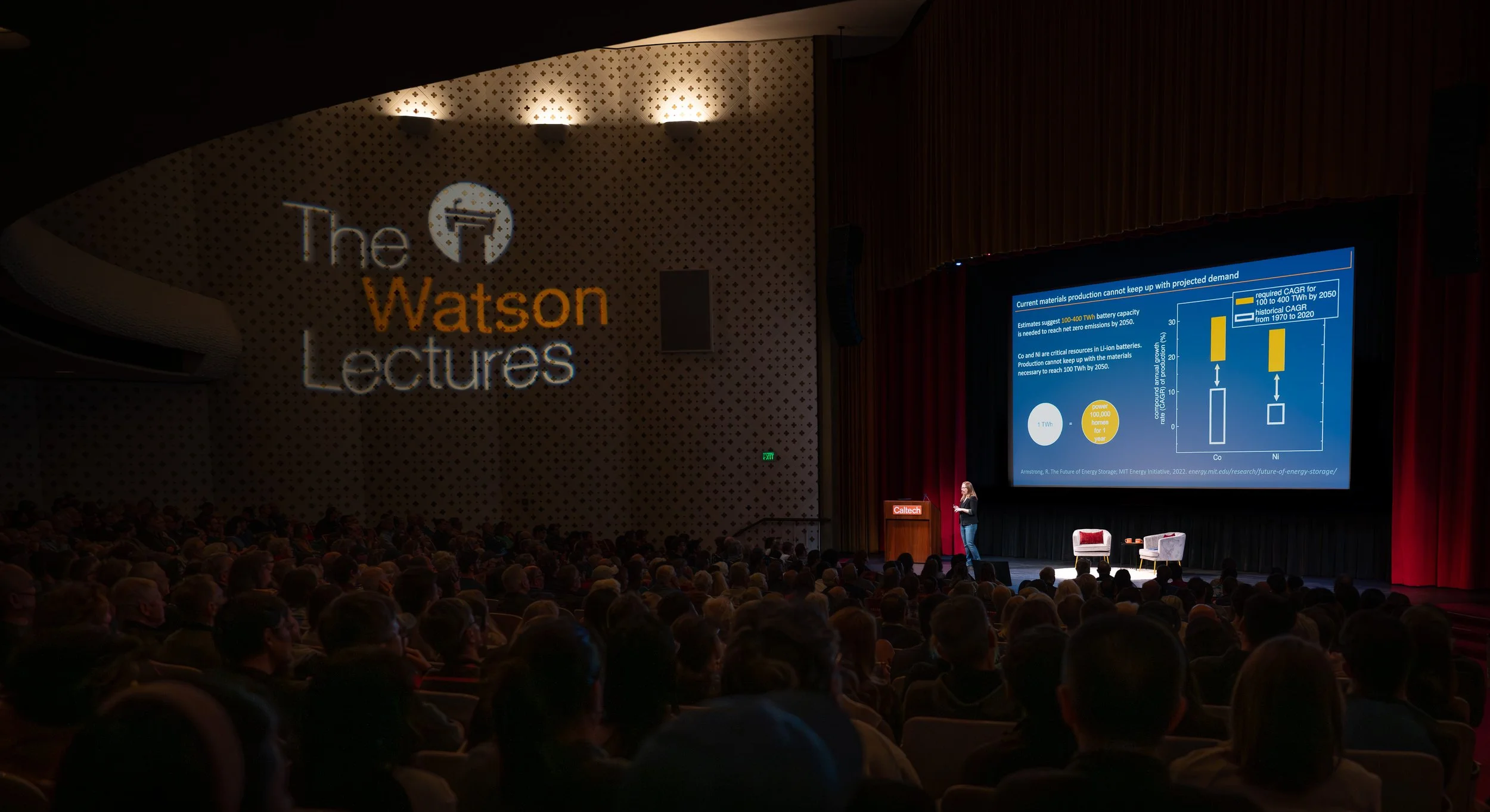
Image: Peter Holderness for Caltech
Learn more about the Watson Lectures and what’s in store for the 2026–27 season at Caltech.edu/Watson.