
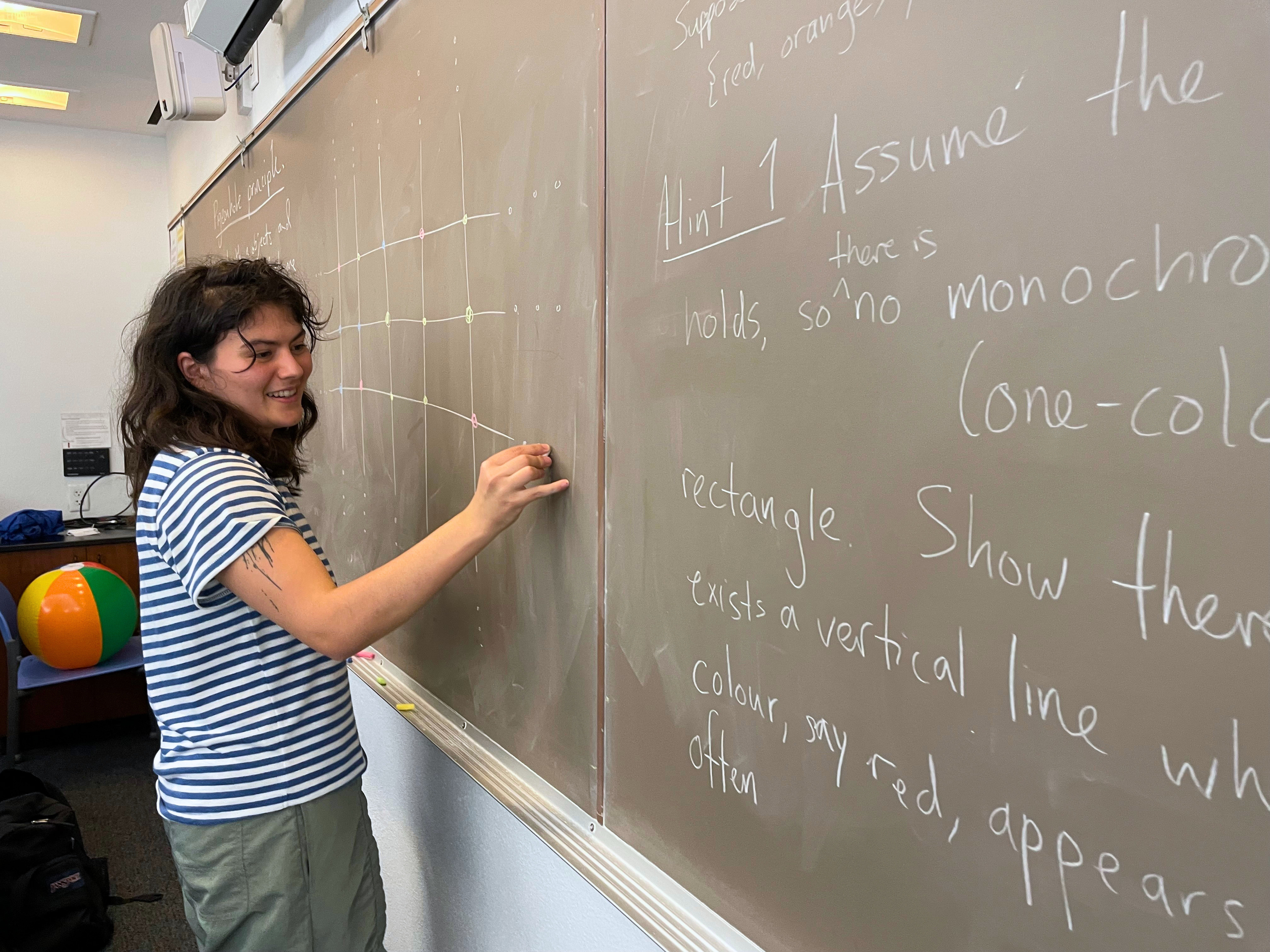
Tasmin Chu, a Caltech graduate student in mathematics and director of the Summer of Math, prepares a math puzzle for the high school student participants. Credit: Sharon W. Tran
Caltech's inaugural session of the Summer of Math program encouraged curious minds from LA's high schools to find the joy in solving math problems.
By Sharon W. Tran
Pairs of students work at whiteboards covered in grids and numbers, their whispered conversations interrupted occasionally by the crinkle of chip bags and the pop of seltzer cans newly opened. These high schoolers need to be properly fueled on the first day of this math program. After all, their instructors—a Caltech math graduate student and a teaching assistant professor—had themselves needed an hour to solve the problem at hand.
Fifteen rising tenth-grade students from 11 local high schools, including Pasadena High School, Mark Keppel High School, and UCLA Community School, came to campus to spend two weeks in June as part of the inaugural session of the Caltech Summer of Math program.
"We wanted to give students a taste of what we think math really is, which is not how to regurgitate somebody else’s solution to a problem but how to solve problems yourself," says Omer Tamuz, Caltech professor of economics and mathematics and "producer" of the Summer of Math program.
A typical program day started with math lessons in the morning, moved into a lunch break, and ended with an afternoon of solving puzzles and riddles. There were also glimpses into Institute labs: One afternoon, the high school students attended a physics demonstration in the lab of Gil Refael, Taylor W. Lawrence Professor of Theoretical Physics; days later, they visited the lab of Joe Parker, professor of biology and biological engineering, to see the ant colonies used in his research.
The idea for Summer of Math started with a lunch conversation between Tamuz; Refael; Ashley Pallie, dean of undergraduate admissions; and Lindsey Malcom-Piqueux, associate vice president for campus climate, engagement, and success. As chair of the First-Year Admissions committee, Tamuz reads applications from students around the world and had noticed that many candidates attended math programs for high school students hosted by peer institutions. The founding group discussed this observation and saw an opportunity to bring the idea closer to home by hosting a similar program for local high school students at Caltech.
With the concept in place, the Office of Undergraduate Admissions directed the program’s outreach toward schools in Pasadena and the Los Angeles area that serve a high proportion of students from lower-income families. To reduce any financial barriers to participation, the program was free and offered a stipend to each student to offset daily travel and other costs.
Students applied by submitting solutions to three math riddles. This, says Tamuz, is a way to identify those who approach problem-solving with curiosity and creativity, regardless of their prior exposure to advanced math. One brainteaser, for instance, asked students to place four points on a plane such that only two distinct distances showed up if you measured the line segments between pairs of points. Two solutions were provided as examples: an equilateral triangle with a point at its center, and a square. The students were asked to find at least one of the four remaining possible solutions, and to explain their logic in a handwritten page. It was the kind of problem whose solution required no special formulas or advanced techniques, just a willingness to experiment and think carefully.
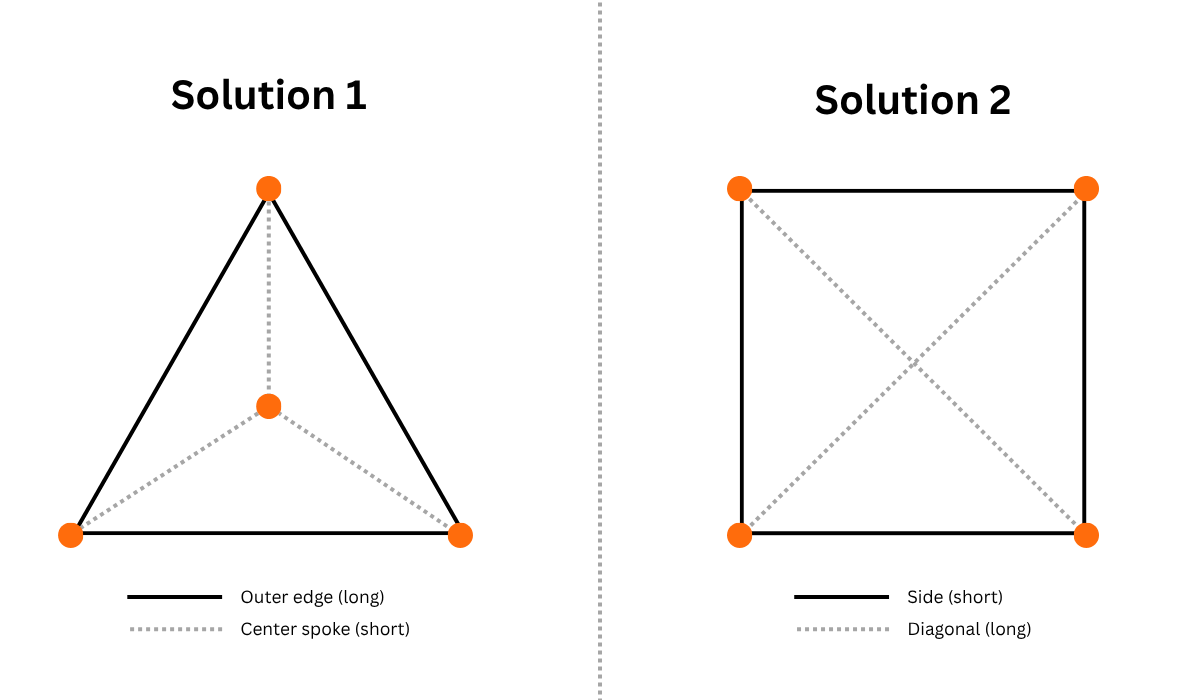
Math riddle solution samples. Credit: Sharon W. Tran
Tasmin Chu, a Caltech graduate student in mathematics, served as the director of the program and spent two terms preparing the program for the Summer of Math students. With the support of Matthew Gherman, the Institute’s Hearst Teaching Assistant Professor in mathematics, along with two undergraduate teaching assistants—Hypatia Hamkins and Christopher Meza—Chu developed a curriculum that challenged the high school students to think like mathematicians. She hoped they would learn some fundamental proof techniques, such as proof by contradiction, which is the practice of assuming the opposite of what you want to prove in order to show that it leads to an impossibility. The organizers also wanted to encourage collaboration through team-focused programming.
"Math is collaborative," Gherman says. "I think the most popular view of math is some random person just off on their own, being a genius. That’s just not how math is done. I would like the students to hopefully take away that there's a lot more interaction with people doing math than in a lot of other pursuits."
Chu saw that spirit emerge from the group. "The students were really brave and very supportive, especially when they presented to each other," Chu says. "They recognized each other’s efforts. For instance, they gave a full round of applause when someone presented a solution on the board to the group."
The Summer of Math program drew on various parts of the Institute: the faculty of the Division of Physics, Mathematics and Astronomy originated the idea and secured institutional support and funding; the Center for Teaching, Learning, and Outreach advised on running summer programs and connecting with local schools; the American Institute of Mathematics, a math nonprofit housed at Caltech, advised on local outreach and student recruitment; the Division of the Humanities and Social Sciences provided the classroom and helped with meals and transportation for the students; and the Office of Undergraduate Admissions led outreach to local schools. In a show of Caltech’s interdisciplinary nature, the ant colony lab visit came together because Chu met John Truong, the research support technician and ant keeper in Parker’s lab, in a drawing class and asked him if the high school students could tour the lab.
On the final day, the students faced one last challenge: a math competition in which groups of 3 to 4 students solved problems and presented their solutions to Chu, Hamkins, and Meza, who scored them on accuracy, clarity, and creativity. Some students who had hesitated to present their work throughout the two weeks found themselves at the board, and, as Chu put it, "did a fantastic job." A lightning round settled the tie between the top two teams. Chu wrote sets on the board and asked whether they were countable—a term for infinite sets whose elements can be listed one by one, like the whole numbers—then drew graphs and asked whether they were bipartite, meaning their vertices can be split into two groups with no edges within either group.
"Doing math is a private mental experience in lots of ways, so I don't think I did that much," Chu says. "The kids really did everything by just showing up and trying."
Two weeks after they first stood at those whiteboards, the students received certificates of completion. "I am so, so, so happy with the results. I’m actually more interested in math," one of the high school students wrote in their feedback form about the program. "I want to come back next year." Another said: "I was able to learn a lot of interesting proof methods and gained more insights on how to approach a problem. This was probably the best decision I’ve made for the summer."