
The Ice at the Far Ends of Earth

Accelerated permafrost thawing has caused the path of Alaska’s Koyukuk River to shift dramatically. Credit: Emily Geyman
Researchers know the planet’s ice is melting; now, they are uncovering what that will mean for all of us.
By Lori Dajose (BS ’15)
The town of Huslia, Alaska, is under siege—not by an invading army, but by water. Most of the homes in Huslia, which is located on the edge of the Arctic Circle, were built in the second half of the 20th century, a time when Alaska’s climate was cooler and the frozen tundra near the banks of the nearby Koyukuk River was reliably hard. But as rising temperatures thaw the perpetually icy ground—called permafrost—beneath the town’s foundations, its homes and businesses are sinking into mud, and the Koyukuk, no longer hemmed in by frozen ground, is shifting erratically, threatening the town with floods and erosion.
For the Yup'ik and Athabaskan people, the Native Alaskans who have made the region their home for millennia, these are unprecedented developments. In 2018, the Yup'ik coined a new word for the catastrophic ground collapse they were experiencing—usteq-meaning “to cave in.” These conditions have now forced many of these people to move, making them some of the world’s first climate refugees, along with others impacted by sea level rise.
Permafrost covers around 18 million square kilometers on Earth, with the vast majority located in the Arctic north. Usteq occurs due to the melting of this permafrost, which took tens of thousands of years to form but has been melting over the course of the last few decades. The millions of cubic miles of ice bound up in ice sheets and glaciers in Antarctica and Greenland are changing as a result of our warming climate as well.
Knowing what is coming is crucial to preparing to counter the effects of warming on the planet. Caltech researchers are conducting ambitious field studies to understand the physical properties governing these frozen regions so that national and local governments are better informed and prepared to respond. These projects include sending autonomous robots and drones to study glaciers from above and below, modeling river erosion due to permafrost thaw, and studying the basic physics of water and ice.
“We know ice is melting, but we don’t yet know how much of it or how quickly,” says geologist Brent Minchew (PhD ’16), who returned to Caltech as a faculty member this year to continue his studies of glaciers and ice sheets. “We cannot solve a problem we don’t understand. To know what kind of future we are looking at, we need to understand the physical phenomena driving these processes.”
Conditions on Earth have been evolving for the planet’s entire history, but the drastic changes experienced at the polar regions—temperature changes of up to four times the global average over the past three decades—are unusual because of how rapidly they are occurring. The Arctic has accumulated permafrost for 2 million years, and yet much of it may disappear in our lifetimes. The results of that melting are already evident: In Alaska, oil pipelines, US military installations, and entire communities are experiencing the ground caving in beneath them as the soil becomes soggy.
If the most extreme climate scenarios come to pass, warming at the polar regions could cause global sea levels to rise by dozens of feet, which would leave metropolitan regions across the planet under hundreds of feet of water. At the same time, the planet could see a quadrupling of carbon in the atmosphere, among other possible impacts.
Life Finds a Way
Melting permafrost is troublesome not only because of the direct damage it can cause to human infrastructure, but because it is a massive reservoir of stored carbon. As long as the ground stays frozen, that carbon is trapped. But when the frozen ground melts, the carbon that had been stored for eons can be mobilized and potentially released into the atmosphere as carbon dioxide and methane, thereby further speeding up the warming.
Geobiologist Woody Fischer studies permafrost in remote landscapes in Alaska, aiming to understand how its loss—and the subsequent release of carbon—will affect future climate scenarios. Permafrost cannot be observed with remote-sensing instruments, so Fischer and his Caltech colleague Mike Lamb, a geomorphologist, along with their research teams, have taken several trips to Alaska to gather samples of permafrost along eroding riverbeds.
Lamb, who is the lead investigator on the permafrost project, and his group are working with several towns in Alaska, including Huslia, to develop models of future river erosion so that communities can prepare and relocate as needed. “Unfortunately, there’s really no stopping it, just adapting,” Fischer says. “We see the rest of the biosphere adapting, and we have to be able to change along with it.”
Among the organisms in the Alaskan biosphere adapting to their new ecosystem are beavers and white spruce, both of which are beginning to colonize areas of tundra that were previously uninhabitable. Salmon, whose populations have plummeted in Alaska’s Yukon River due in part to climate change, are now found even farther north than before. “Salmon are a kind of vector animal that transport nutrients from the ocean into the land when they swim up rivers and die,” Fischer says. “They’re ecological founders in addition to being an important food source.”
Lamb adds that while erosion in many rivers like the Koyukuk near Huslia is speeding up as permafrost banks thaw, some rivers farther north are slowing down.“We have an improving but still poor understanding about the response of permafrost landscapes to warming,” he says, noting graduate student Emily Geyman from his lab attributed the unexpected slowing of erosion to less violent ice breakup events each spring.
These developments offer some hope. As more plants and trees begin to grow in newly thawed ground, these organisms will absorb carbon from the atmosphere. Preliminary research conducted by Fischer and Lamb suggests that the biosphere’s greenery may be able to absorb most of the carbon released from the ground in the region, partially offsetting the climate effects of the melting and preventing worst-case scenarios.
Still, according to Carl Burgett, first chief of the Huslia tribe, the melting permafrost is threatening at least a third of the community’s land. “With the new data we collected, hopefully a relocation plan can be funded for our community along with much-needed infrastructure,” Burgett says. “It’s been an honor working with Caltech and that they selected our little community to measure permafrost thaw.”
Measuring Glaciers from Above
Even though permafrost thawing is devastating communities, it is not the water released from the frozen tundra that will significantly impact sea level rise around the world. Instead, that threat lies in the ice that largely takes the form of glaciers, which cover Antarctica and Greenland in thick ice sheets. Therefore, understanding how glaciers will be affected as the climate warms has crucial implications for predicting, adapting to, and mitigating sea level rise.
The most extreme estimates of sea level rise hinge on the behavior of one particular glacier in Antarctica: the Thwaites Glacier, which the media have dubbed the Doomsday Glacier. The size of Florida, Thwaites’s collapse would expose a billion people to the risks of sea level rise this century.
That is why Minchew, the geologist, is working to better understand how ice sheets might evolve over human timescales. When he was a Caltech grad student working with geophysicist Mark Simons, Minchew studied the mechanics of how glaciers flow and deform the beds of soil beneath them. Now, as a faculty member, he aims to observe the ice sheets from the skies, using drones equipped with radar technology.
Minchew is developing solar-powered drones that will fly above Antarctica and Greenland over a period of months, collecting radar observations of glacier flow velocity, as well as the glaciers’ elevation and how that changes over time. These detailed measurements will enable Minchew and his team to watch how fractures in the ice propagate, especially in response to the ebb and flow of ocean tides. “How quickly does the ice flow? Under what conditions does it fracture? How do the oceans and the ice sheets evolve together? These are the sorts of questions we’ll be asking.”
Minchew’s observations will be supplemented by data from the NISAR (NASA-ISRO Synthetic Aperture Radar) satellite, which launched in July 2025. Simons, Minchew’s graduate advisor and now director of the Institute’s Brinson Exploration Hub, serves as a science lead on the mission. NISAR carries two kinds of radars that will monitor soil moisture, forest biomass, and the motion of Earth’s crust in addition to the behavior and evolution of ice sheets.
“In the best-case scenario—without a Thwaites collapse and with aggressive decarbonization of the economy—we’re looking at something like half a meter to a meter of sea level rise, a few hundred million people displaced, and major cities like Shanghai, Bangkok, Kolkata, Buenos Aires, and Miami largely underwater within my daughter’s lifetime,” Minchew says. “But there’s a lot of uncertainty in those projections. We hope our work will take some of that uncertainty away.”
The Physics of Water and Ice
Glaciers may seem like giant versions of the ice cubes in your freezer, but they are, in fact, incredibly complex. These kilometers-thick ice sheets are full of internal cracks and crevices, and they are topped with a layer of crusty, compressed snow, called firn, that can be tens of meters thick.
Scientists like hydrologist Ruby Fu are interested in studying how the water that forms when firn melts subsequently interacts with the rest of the glacier’s underlying ice. Her team wants to observe whether that water will flow out to the ocean and contribute to sea level rise immediately, refreeze within the glacier, or percolate down to the glacier’s base and act as a lubricant, speeding up the glacier’s otherwise slow slide into the ocean.
Fu did not expect to study water and ice interactions when she joined the Caltech faculty in 2021, but the rapid changes at the polar regions instilled in her a sense of urgency. As a fluid mechanics expert, she knew she could contribute to understanding the processes that enhance or inhibit sea level rise.
“For centuries, people have been trying to figure out how water moves through the natural environment,” Fu says. “Right now, with climate warming, we’re trying to understand the movement of water in frozen glacier systems, especially in polar ice sheets. Our lab research will help explain how surface-produced meltwater might be introduced to the base of the ice sheet if it doesn’t refreeze on its way down.” Fu, who has never been atop a glacier (“I don’t even ski!” she notes), creates analog experiments in the laboratory to study how flowing water interacts with porous ice, because such behaviors cannot be seen through a massive and opaque glacier. The experiments are conducted in a homemade, ultracold refrigerator built by Caltech graduate student Nathan Jones to simulate the frigid environments of Antarctica and Greenland. Fu also aims to study how millions of snowflakes congeal into ice at once, a project for which she consulted with Caltech physics professor Ken Libbrecht, who is well known for his research on the crystalline structures of individual snowflakes.
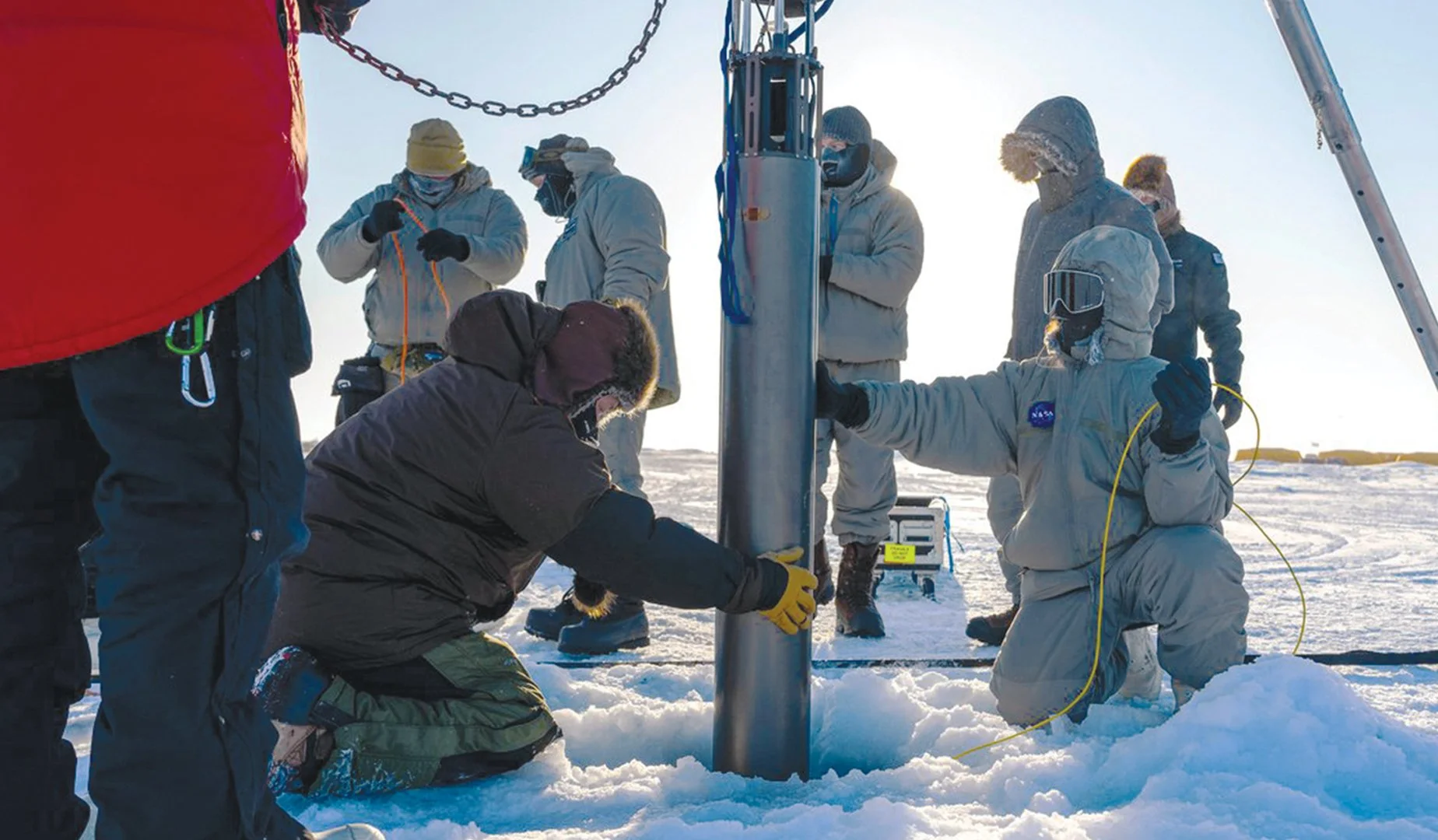
Members of the IceNode project team deploy an autonomous underwater robotic vehicle in Alaska earlier this year. Credit: Courtesy of A. Thompson
In one experiment, water dyed a fluorescent green percolates down through a thin layer of tiny frozen glass beads that mimic firn. A camera captures the water’s path, finding that it often travels quite far before freezing, particularly if the water was warm to begin with. “People tend to think about freezing as a very binary thing,” Fu says. “We were taught in school that if it’s below zero, water will freeze. But, in reality, freezing takes time and can be complicated. Water can, in fact, travel quite far in a cold and icy environment before it becomes frozen.”
Fu’s research offers insights into the conditions that other collaborators are attempting to model in the field. These researchers include Caltech environmental scientist and engineer Andrew Thompson, whose team will deploy technology in Antarctica as part of a project called SURGE (SUbsurface Robotics for Grounding zone Exploration) to measure glacial freezing and melting, supported by Fu’s models of the basic physical properties occurring in inaccessible regions.
Measuring Glaciers from Below
It is rare to get the opportunity to take measurements in Antarctica, due to its hostile and remote environment. So, Thompson takes every chance he can to travel to the pole where, on board a massive research ship, he and researchers from around the world work 24/7 in frigid temperatures amid the sounds of cracking ice.
But these kinds of in-person voyages remain extremely expensive and infrequent, which is why Thompson is working with colleagues at the Jet Propulsion Laboratory, which Caltech manages for NASA, to develop and deploy a small underwater drone, called IceNode, that can attach to the nearly inaccessible underbellies of ice shelves (floating extensions of glaciers) and record ocean conditions at the ice–ocean interface. If this proof-of-concept project is successful, fleets of these vehicles could be deployed to various Antarctic ice shelves to measure temperature, salinity, density, and other properties of the water to reveal how quickly the glaciers are melting and what kinds of future scenarios humans must prepare for.
In particular, Thompson and his collaborators aim to understand a mysterious area known as the grounding zone, where ice, ocean, and seafloor all meet. As glaciers flow off the Antarctic continent and into the ocean, they eventually become thin enough to lift off the seafloor and float on the ocean surface. These ice shelves sit atop a region known as an ice-shelf cavity, which can reach tens of kilometers in length. Within these cavities, relatively warm ocean water circulates, melting the ice from below.
These interactions between seawater, the ocean floor, and the ice shelves are not simple, and most models of warming do not account for them. “Even the most advanced models are missing fundamental processes, specifically the ocean–ice interactions that occur where the warmest waters first touch the glacier,” Thompson says. “Those interactions could be the difference between a meter of sea level rise in the next 80 years or two to three times that amount over the same period.”
Seismic Signatures of Ice
While Thompson aims to measure water properties with SURGE, seismologist Zhongwen Zhan (PhD ’14) is working on a project to bring the techniques of earthquake science to the study of glaciers. For over a decade, Zhan has been developing a new kind of seismometer system called distributed acoustic sensing (DAS) that uses fiber-optic cables—the same kind that provide high-speed internet to cities and towns around the world—as makeshift seismometers. The system shoots lasers down these cables and measures how the light bends as the cables vibrate during seismic activity. This movement provides information about the ground’s structure.
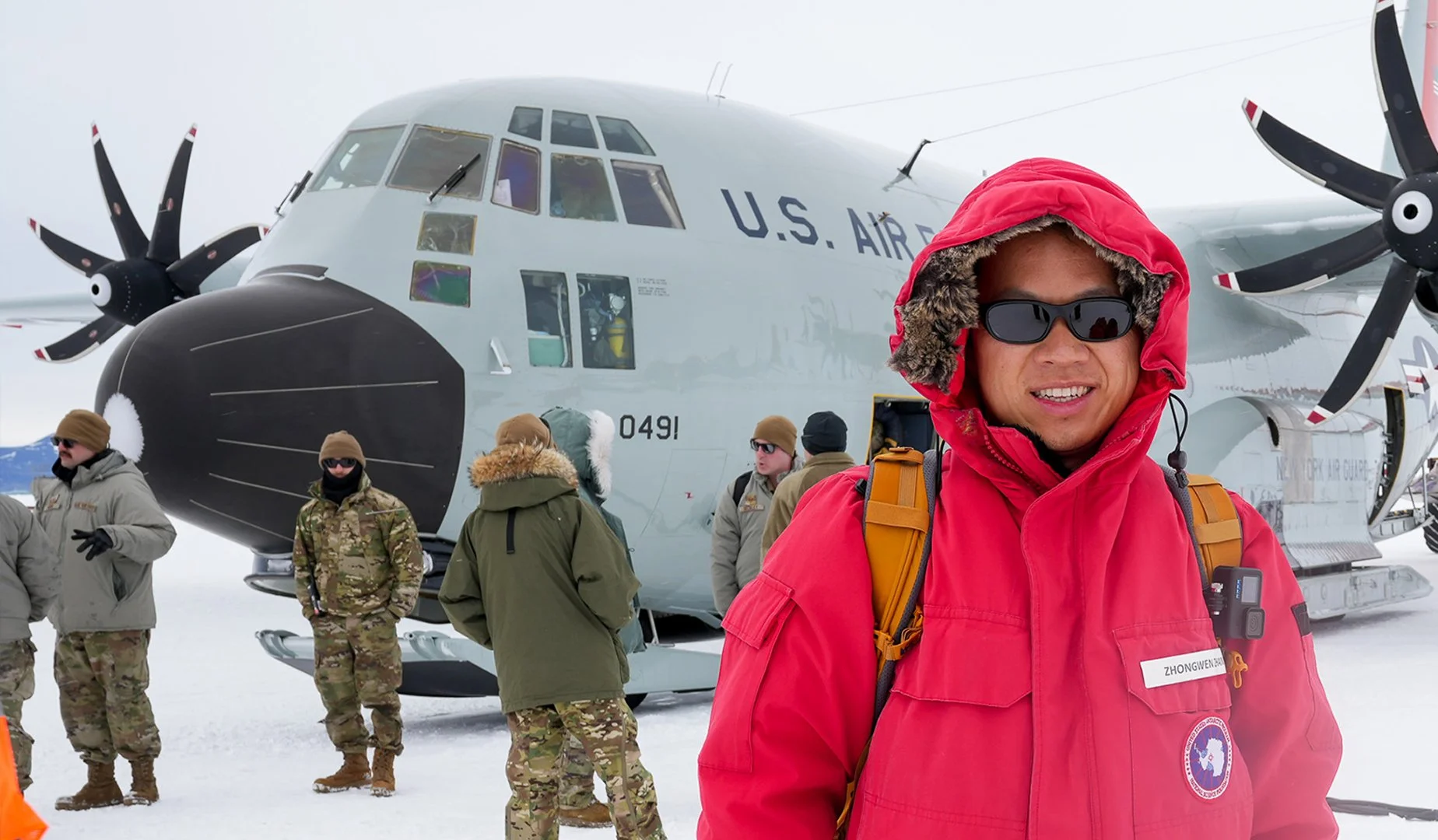
Zhongwen Zhan(PhD ’14), prepares to board a flight to Antarctica in 2023. Credit: Courtesy of Zhongwen Zhan
Antarctica experiences very few earthquakes. Its glaciers, however, creak and tremble as they move, particularly as they rock up and down with the tides. This movement can be picked up by seismic sensors. Zhan aims to use his fiber-optic DAS system to measure how the grounding zone shifts due to the tides in order to better understand how the region may be melting with warmer waters.
In a separate project last year, Zhan and his team deployed their DAS technology in Iceland in order to provide warnings up to 30 minutes in advance of lava eruptions, whose vibrations are picked up by the fiberoptic cables. “We’ve done a lot with DAS in the past, but this is different,” Zhan says. “We’re pushing the technology in ways we haven’t before—designing for extreme conditions, building quickly, and aiming for real scientific return on a short timeline. We’re not just testing a new instrument; we’re trying to unlock a part of Earth that’s been hidden.”
Though prior DAS projects took advantage of fiberoptic cables already installed underground, the glacier project will require new cables to be specially deployed. The team is currently developing a lightweight, energy-efficient version of DAS that can withstand the harsh Antarctic environment.
Thompson’s and Zhan’s projects are both partially funded by the Brinson Exploration Hub, for which Simons serves as director. Launched in 2024 through a $100 million gift from The Brinson Foundation, the Brinson Hub empowers scientists and engineers from Caltech’s campus and JPL to collaborate on boundary-pushing science projects that develop and test new research and instrumentation, and deepen our understanding of the universe.
Two of the three projects in the Brinson Hub’s first round of funding focus on Antarctica. “Antarctica is an ambitious place to explore,” says Simons, the Brinson Hub director. “It’s one of the last frontiers on the planet, yet it is key to understanding what the future of our world will look like.”
Editor’s note: The story has been updated to reflect Michael Lamb’s status as lead investigator of the permafrost project, as well as his roles in the development of river erosion models and arctic biosphere greenery research.
Woody Fischer is the Jean-Lou Chameau Professor of Geobiology. His work is funded by Caltech’s Resnick Sustainability Institute (RSI) and the National Science Foundation (NSF).
Ruby Fu is an assistant professor of mechanical and civil engineering and a William H. Hurt Scholar. Her work is funded by the RSI and NSF, among others.
Michael Lamb is a professor of geology. His work is funded by the RSI and NSF.
Brent Minchew is a professor of geophysics. His work is funded by the NSF and NASA, among others.
Mark Simons is the John W. and Herberta M. Miles Professor of Geophysics and director of the Brinson Exploration Hub. His work is funded by NASA and others.
Andrew Thompson is the John S. and Sherry Chen Professor of Environmental Science and Engineering and director of the Ronald and Maxine Linde Center for Global Environmental Science. His work is funded by the Brinson Exploration Hub, RSI, NASA, and NSF, among others.
Zhongwen Zhan (PhD ’14) is a professor of geophysics and the Clarence R. Allen Leadership Chair and director of the Caltech Seismological Laboratory. His work is funded by the NSF and the Brinson Exploration Hub, among others.