
Amplifying a 75-year Radio Career
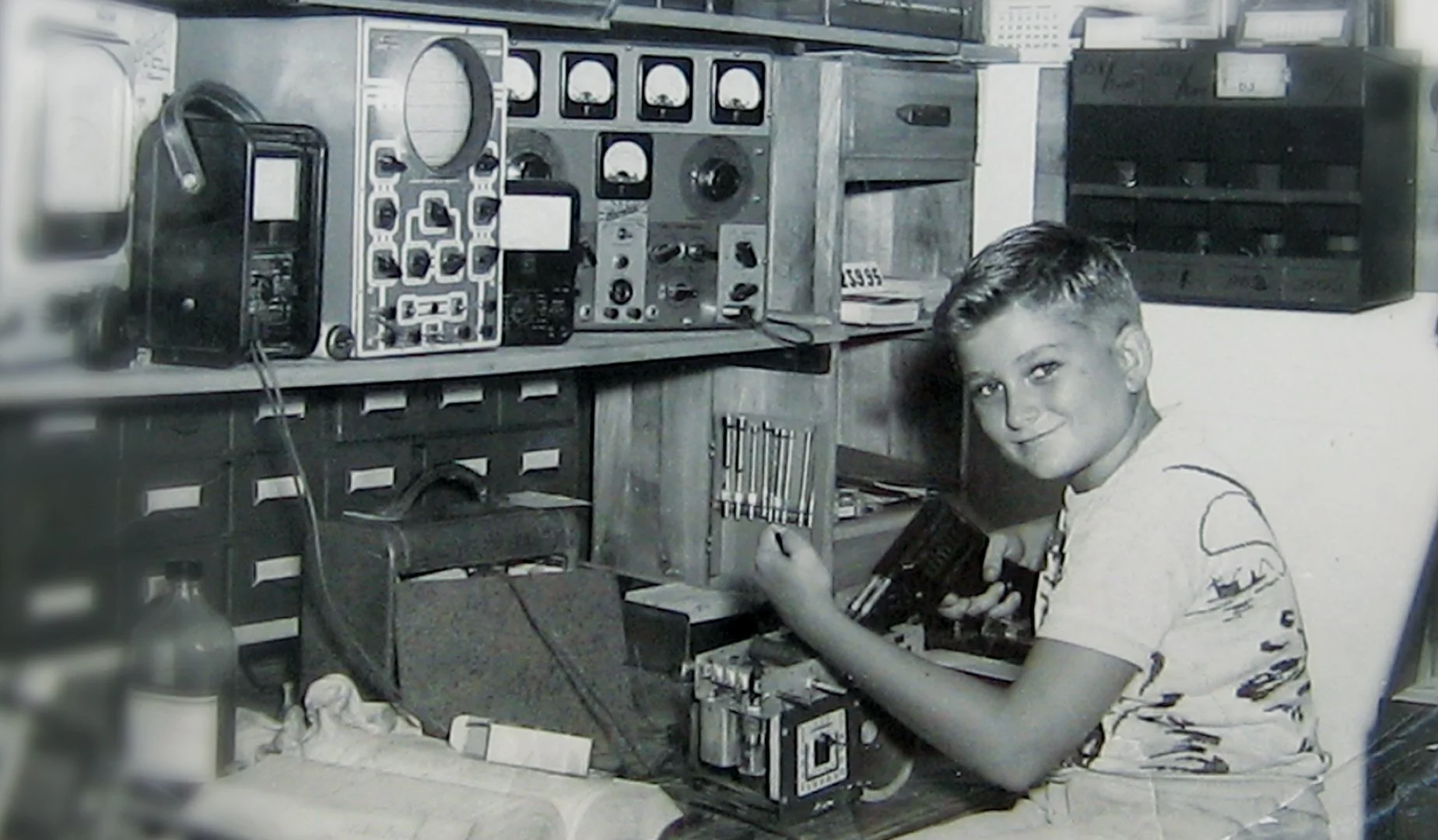
Courtesy of Sandy Weinreb.
Four questions for Caltech radio astronomer Sandy Weinreb.
Sandy Weinreb has spent most of his career perfecting the design of radio astronomy receivers, small critical components of radio telescopes that amplify and digitize feeble radio waves from the cosmos. Weinreb joined Caltech in 1999 and is currently an emeritus research associate in astronomy at the Institute. He spearheaded development of uncooled low-noise amplifiers that will debut on Caltech’s Deep Synoptic Array (DSA-2000) radio telescope, an array of thousands of dishes to be built in the Nevada desert over the next couple years. The amplifiers are groundbreaking because they do not require cooling with expensive cryogenic refrigerators. “Personally, I think Sandy has a legacy of instrumentation development in radio astronomy that is second to none,” says Gregg Hallinan, a Caltech professor of astronomy, DSA-2000’s principal investigator, and director of the Institute’s Owens Valley Radio Observatory, where a team has been building prototype radio dishes for the DSA. Here, we speak with Weinreb, now 88, about his background and work.
What drew you to radio astronomy?
By age 12, I was fixing radios and TVs in repair shops (at right) to help my parents pay the rent. I became interested in radio astronomy while looking for a summer job at MIT as an undergrad. I looked through the Boston phone book and ended up finding a company run by Harold (Doc) Ewen, who discovered the interstellar hydrogen line at Harvard in 1951. This was a big deal in radio astronomy. This hydrogen emission line allows astronomers to study galaxies across the universe. When I visited Ewen’s company, I remember that he was sitting on a platform, like a Buddha, with people around the outside who were building receiver components. Somebody explained I was from MIT and looking for a job. Doc said, “Let’s give him a buck and get him going.” Ten years later, I worked at the National Radio Astronomy Observatory (NRAO) in West Virginia as head of the electronics division.
Why are amplifiers so important in radio astronomy receivers?
Low-noise amplifiers determine the sensitivity of the observations. We want to detect faint radio waves from the universe, but our amplifiers can produce their own background noise, like a hiss. We developed ways to minimize that noise by cooling the device.
What prompted you to start working on uncooled low-noise amplifiers?
I knew that future radio astronomy observatories would utilize arrays of small antennas that could be combined to provide images of the radio sky. However, each antenna would require an expensive cryogenic cooler that would dominate the cost and limit the number of antennas, which would then limit the number of pixels in the image. Gregg Hallinan told me about the DSA and that he and his team intended to image a large area of sky. To be affordable, this required large numbers of uncooled low-noise amplifiers.
How did you figure out how to make them?
I started by looking at superior transistors with much lower noise being developed using indium phosphide semiconductors by groups in the US, Sweden, and Switzerland. I also knew that the usual solder method for printed circuit packaging increased the noise, so I turned to wire bonding of a bare transistor chip. This requires much skill to handle the millimeter-sized chip. The low-noise amplifier design was further improved by Caltech research engineer Kiran Shila [PhD ’25] as part of their PhD thesis using machine learning techniques.