
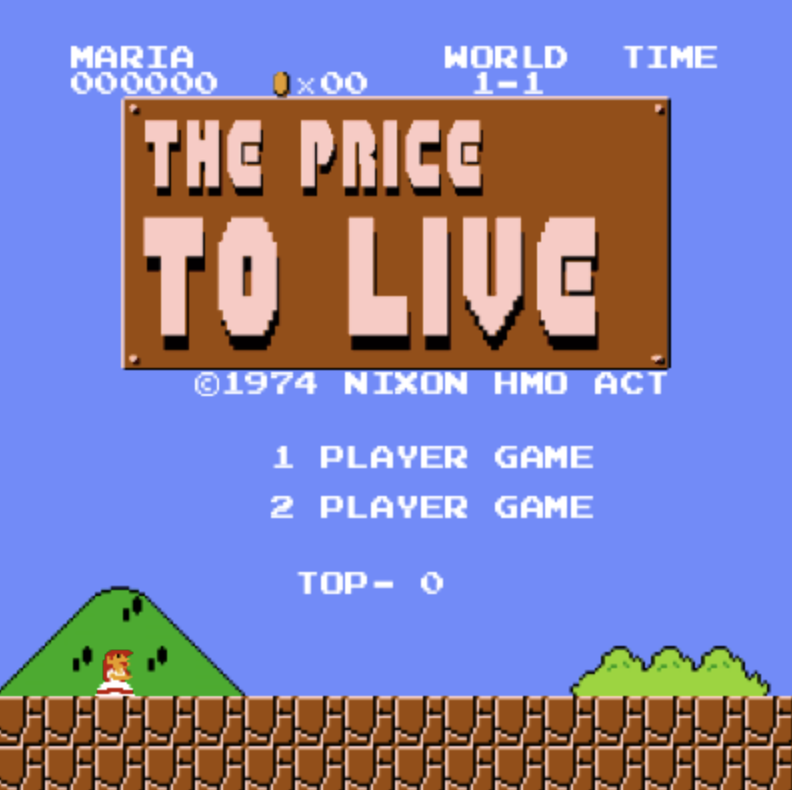
Screenshot of The Price to Live. Credit: Pranav Patil.
By Cynthia Eller
In the winter of 2024, Pranav Patil (BS ’24) had an epiphany. A Caltech computer science major from San Diego, Patil was considering which classes he should take in his final term at the Institute when he thought, "I'm going to enter the real world soon, and my problems are not going to be the meal plan at Caltech. So, I stopped asking, What will make me a super cool CS guy? and instead started wondering, What will help me learn about how the world works?"
Patil's solution was to sign up for three courses: Pedagogy in Computer Science, Introduction to Public Health Economics and Policy, and Visual Activism. The combination turned out to be fortuitous. In the visual activism course, where Patil was asked to find something that really mattered to him, he was able to combine his courses in both computer science education and public health economics with his personal experiences to ultimately create a video game about the problems with the American health care system.
"I was injured at the time," Patil says, "and I was seeing how being on crutches affected my ability to engage in the world and in the spaces at Caltech. I was very frustrated with health care at the time. Plus, over the previous couple of years, my mom had had some health issues. We were lucky to be in a financial spot to handle that, but it made me realize that if we weren't in that position, health issues would become a lot scarier. And they're already scary enough."
Patil wanted to communicate his frustrations with health care in a visual way. "One of the key principles in the visual activism class is that you can show someone a statistic, but that doesn't mean you can get them to feel it. Numbers like a hundred, a thousand, a hundred thousand—they all feel big. Is there a way you can visualize a statistic? How do you put someone in the shoes of a person who is screwed over by the health care system?"
Patil landed on video games, an area where he had some expertise. In high school, he created video games that were meant to teach elementary school children to code. He realized he could take those experiences into his visual activism course as well. "To really communicate the role of luck in people's experience with health care, I needed an interactive medium where you get people to step into another world," Patil says. "That had to be a video game.”
Having learned in his health care policy class that health maintenance organizations (HMOs) were privatized in 1973 with an act signed by Richard Nixon, Patil decided to use a video game format more or less contemporaneous with this change in American health care policy: Super Mario Brothers.
"Super Mario Brothers has existed for about 40 years. It's so pure. You're just finding coins, innocently exploring. That is a set of expectations, and if I could in some way disrupt those expectations, I figured that could be really impactful," Patil says. "I wanted to make a game where you're trying to find coins, but instead of earning more and more lives, the way you do in Super Mario Brothers, it would be more like reality, where you have one life, and if you don't find enough coins, you die. In the original game, the Goombas are a feeble opponent. They hardly move and are easy to dodge. When your life situation changes though, the Goombas become extremely powerful. In my game, the Goombas represent how the Nixon-era HMO Act was not a problem for most people, but if you experience a random health crisis, you might suddenly be faced with super-Nixon-Goombas that you didn't realize existed."
Patil sketched out plans for the game, which he called The Price to Live" as his final project for the visual activism class. But when Anna Stielau, Weisman Postdoctoral Instructor in Visual Culture, challenged him to actually build the game, Patil decided to give it a shot. He was about to depart on a trip to Europe with friends to celebrate their graduation and thought "OK, I have a 16-hour flight. Let's see what this Caltech CS education can do. Let's see if I can build this game."
The flight didn't prove to be long enough, but Patil was so excited about the project that he continued to work on it while riding the rails across Italy. Afterwards, with Stielau's encouragement, Patil sent his video game, along with an artist's statement, to InVisible Culture: A Journal for Visual Culture, where it was accepted for publication.
Patil says that some of his friends "wouldn't stop playing the game because they were determined to find a way to win—ultimately realizing it was impossible. After playing the game, you might say 'This is too hard! That's not fair!' And that's precisely my point."
You can play The Price to Live here.