
The Remarkably Slow Speed of Thought

Image: Flickr/ Joe Lewis
New research confirms the human brain makes decisions at a leisurely rate. But why?
By Katie Neith
The idea came to Markus Meister, as his research projects often do, in the middle of a neuroscience class.
Meister, the Anne P. and Benjamin F. Biaggini Professor of Biological Sciences, was teaching his Caltech students how to apply concepts of information theory—a branch of mathematics used to define and quantify information—to different parts of the human nervous system. “The key substance that flows through the nervous system is information in the same way that the key substance flowing through the vascular system is blood,” he says. “Just as you can measure things about blood like volume, flow rate, and pressure, you can measure things about information, like the amounts and flow rates in different neural links.”
Suddenly, a question arose: Just how much information can flow through an entire human being? In this information age, it can feel like the mind is going a mile a minute, absorbing massive amounts of data and acting on it quickly. But Meister and Jieyu Zheng, a graduate student in neurobiology, found just the opposite: Despite how much stimulation bombards us at every moment, the human brain’s information processing maxes out at around 10 bits per second (bps). By comparison, a high-quality streaming rate for a YouTube video is roughly 8 million bps.

Jieyu Zheng. Image courtesy J. Zheng
Zheng became lead author on a paper in Neuron about the project, “The unbearable slowness of being: Why do we live at 10 bits/s?” But even she could not accept her own finding at first. “I didn’t believe our brains are slower than the internet,” she said, “so I started to look through the literature—basically every example in the past century—and found that 10 bits per second really holds true. This poses a big paradox and conundrum: Why do we live at 10 bits per second when our neurons could do much more?”
To Colin Camerer, Caltech’s Robert Kirby Professor of Behavioral Economics and T&C Chen Center for Social and Decision Neuroscience (SDN) Leadership Chair and director, the study raises a fundamental but neglected question that underlies a host of scientific fields. “Our behavioral information processing output rate is slow, but our world is a ‘Hoover Dam’ of input that is much faster,” he says. “This impinges on almost everything, including maximal human performance.”
Zheng and Meister did not conduct a battery of experiments to arrive at 10 bps. Instead, they combed through studies, popular science articles, and Guinness World Records to find activities where the speed of thought was measured across various behaviors and tasks, gathering insights from across decades of work in fields that don’t regularly communicate much, like engineering and psychology or some subcultures of neuroscience. They all led to the same conclusion: Human information throughput, including motor function, perception, and cognition, moves at a snail’s pace.
“That speed limit of 10 bits per second applies to all kinds of different tasks, from the very simple, like moving a pencil rapidly between dots on the page, to the seemingly complex, like solving a Rubik’s Cube with your eyes closed,” Meister says. “It also applies to tasks where you don’t have to move any muscles, and, we argue, even to pure thought.”
Meister first began to introduce early findings from his investigation of neural flow rates in the late 2010s in lectures that featured the example of typists. A skilled typist makes decisions by pressing keys at a rate of about 10 characters per second. Information theory holds that one character of English corresponds to about one bit of information, so the typist processes information at 10 bps.
In 2020, Zheng heard Meister give the same example while she was a first-year student in his Principles of Neuroscience class. She became interested in confirming whether the rate of 10 bps holds up across other behaviors. Zheng wanted to do a rotation with experiments in Meister’s lab but was stuck in China due to the COVID-19 pandemic. So, Meister proposed she do a literature review to find additional examples of tasks with a measurable rate of information flow.

Artwork by Jieyu Zheng illustrating the concept of the 10 bits/second speed limit of thought. Image: J. Zheng.
Zheng looked for previous studies that measured tasks such as reading and typing in English or playing Tetris and other video games in a competitive speed-dependent setting. To convert different measurements (like reaction time or object recognition) into bits, she borrowed equations from information theory. Even some of what we would consider the most difficult tasks, like breaking the record for solving a Rubik’s Cube blindfolded, clocked in below 10 bps.
The way that many of these tasks are performed primarily involves visual input. Even the Rubik’s Cube champion assessed the cube before being blindfolded. But Zheng also found evidence that auditory input functions at the same slow speed. For example, the recommended speaking rate when giving a talk, regardless of language, sits close to 10 bps.
Having found such a counterintuitive number for the speed of thought, Zheng and Meister went to great lengths to investigate any holes in their logic, employing colleagues from a range of fields to challenge their findings. “It took a couple of years to convince ourselves that we had defended every possible question and were ready to offer a conclusion,” Zheng says.
Electrophysiologist and neuroscientist Ueli Rutishauser (PhD ’08), who is a faculty associate in biology and biological engineering at Caltech and directs the Center for Neural Science and Medicine at Cedars-Sinai Medical Center, said he was surprised at the limit Meister mentioned when they first started discussing the idea.
“Naively, you think we are this high-bit-rate machine,” Rutishauser says. “But when you really push the system, like with the speed-cuber, and calculate the information that the guy needs to put out, it’s not that much. I think it shows the power of actually quantifying things rather than just talking about them.”
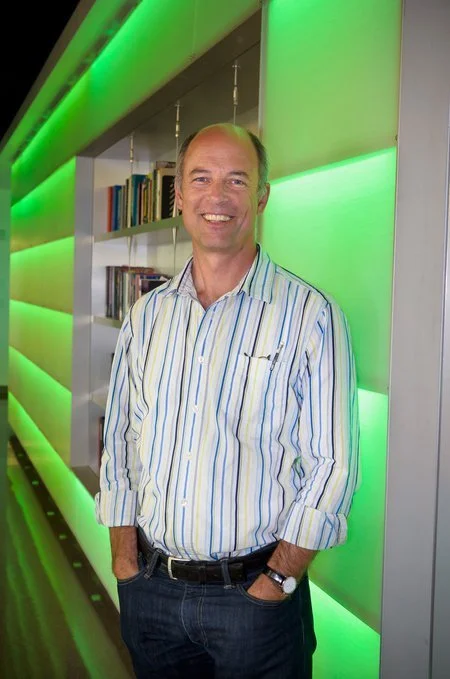
Markus Meister. Image: Lance Hayashida
Frederick Eberhardt, a professor of philosophy at Caltech who has an interest in cognitive science, was another colleague who offered early challenges to the team’s findings. He says he’s intrigued by the idea that human cognition could indeed be fully captured at 10 bps. “If this is true, there is a massive amount to be learned from how the brain manages to extract just the right information efficiently,” he says.
One crucial caveat, Meister says, is that the study measured activities involving mostly conscious processing, which requires the involvement of some level of awareness. He points out that some commentators suggested that the brain processes much more information on an unconscious level in a way we cannot yet quantify. “In principle, that’s possible, but we just haven’t seen any evidence for it,” Meister says. “I’d like to find an instance where you can prove that someone has either learned something or generated responses in a way that is much faster than expected and that it involves unconscious processing. But so far, I regard this as a theoretical limitation, because there’s no actual known counterexample.”
Zheng and Meister’s attempt to answer one deceptively complex question has challenged traditional views on brain function. To Meister, perhaps the most important mystery is the enormous apparent discrepancy between processing in the peripheral brain, the outer regions, where sensory input like sight and sound enters the organ, and the inner brain, where input is turned into action. The information rates between the two differ by a factor of 100 million.
To understand the difference in information processing between the two systems, Zheng says, imagine yourself at a cocktail party. Information that flows through your sensory organs to the outer brain allows you to see, smell, and hear many things in the environment around you, in a general sense. But you can only perform one task at a time, like listening to a single conversation instead of truly hearing all the gossip being spoken in a room.
This suggests that there’s a common bottleneck in brain processing that limits all these behaviors to an extremely low rate. Yet the biological reason for that bottleneck is a mystery, Meister says. “Somehow that giant stream of information gets winnowed down to a tiny trickle in a process we call ‘sifting’ that ultimately controls what we do, but we remain unsure of how this works,” he notes.
For example, the primary visual cortex, in the outer brain, and the prefrontal cortex, in the inner brain, each contain about a billion neurons. Meister says scientists have a pretty good model of why the primary visual cortex needs so many neurons: It processes visual scenes separately at many thousands of locations in a given image. But in the case of the prefrontal cortex, where not as much scientific progress has been made in elucidating its role in processing information, there is no such plausible explanation.
“The key substance that flows through the nervous system is information in the same way that the key substance flowing through the vascular system is blood.”
“You hear about prefrontal cortex all the time. It’s supposed to be the seat of personality and part of the brain that controls executive function, which is crucial to managing our thoughts and actions,” Meister says. “But in reality, we really have no mechanistic understanding of what that part of the brain does.”
Meister says this paradox is not about some circumstantial tidbit of brain science but right at the heart of human cognition. “I would be happy if some enterprising young scientists are motivated to take this on and direct their ingenuity toward this area, where there’s an enormous opportunity to expand our understanding of the brain,” he says.
Zheng is doing her part by exploring cognitive flexibility in mice for her thesis, which could give us clues about whether the cortex in mice has a fundamental role in cognition and whether it is analogous to the human cortex, which can only do one thing at a time despite having the power of billions of neurons.
Eberhardt, too, says he was perplexed by the discrepancy in processing speed, especially given that there is no lack of “hardware” for the inner brain. “Put this in contrast to artificial intelligence, where vastly more than 10 bits per second can be processed and developers always want more computing power, but the resulting artificial thought is still only a glimmer compared to what humans seem to be able to do. The pieces don’t line up,” Eberhardt says. “I wonder whether the discrepancy could be explained developmentally: Do we need an enormous amount of redundancy in order for the appropriate connections to develop?”
Camerer hypothesizes that, perhaps, the reason for the discrepancy is that experimental designs struggle to show the full capabilities of the inner brain.
“One useful step forward is to study much more complicated tasks at which people are often good—and can become extraordinary—to figure out how other processes produce such amazing performances even if there’s a 10-bit-per-second constraint,” says Camerer, who notes that he and colleagues in the Chen Center have been interested in studying extremely expert performances neuropsychologically, such as math skills in Caltech undergraduates. “This is a general area funding agencies interested in brain disease have neglected.”
Then there is the question of how to study micro-tasking, our ability to choose whichever 10 bits per second we need to pay attention to as part of a bigger overall goal, such as driving. “We can check our speed on the dashboard, look out the windshield, check the front-view and rear-view mirrors, but not at the same time—we really can’t do two things at once,” Zheng says. “All of these little tasks are serving the same goal, so how is that controlled?”
Meister plans to delve into some of these questions soon, too. Together with Rutishauser and two graduate students, he aims to develop a new kind of experiment to better understand brain processing. Building on historical findings that show that people with lesions in the frontal lobe—where the prefrontal cortex is located—can perform simple tasks but cannot string long sequences of them together to achieve complex goals, the team is working to get a closer look at activity in this brain region.
“One reason we don’t know why so many neurons are needed in the inner brain is because complex tasks, like driving a car, can’t be tested in animals,” says Rutishauser. “We need to find ways to study the activity of neurons while humans are performing such goal-directed tasks. Doing so is invasive and not possible in healthy volunteers, but we can do such research by collaborating with neurosurgeons.”
To that end, the research team is collaborating with Rutishauser’s clinical colleagues at Cedars-Sinai to record neuron activity in patients with epilepsy who have electrodes temporarily implanted in their frontal cortex to monitor seizures. The electrodes allow them to employ a technique called human single-neuron recordings to document the activity of many individual neurons at the same time. This tool lets the team examine what neurons located in the “inner brain” are doing when patients perform a complex task such as driving a simulated car.
“By observing humans under conditions where they’re engaging in natural and fast-paced behavior, where they’re making decisions at a substantial rate and perhaps getting close to the 10-bits-per-second limit, one has a better chance of understanding why that part of the brain needs such a great amount of neural complexity,” Meister says. “And that’s what we’re trying to accomplish in our new research focus.”