
The Explorer Class: Building the Quantum Internet with Maria Spiropulu
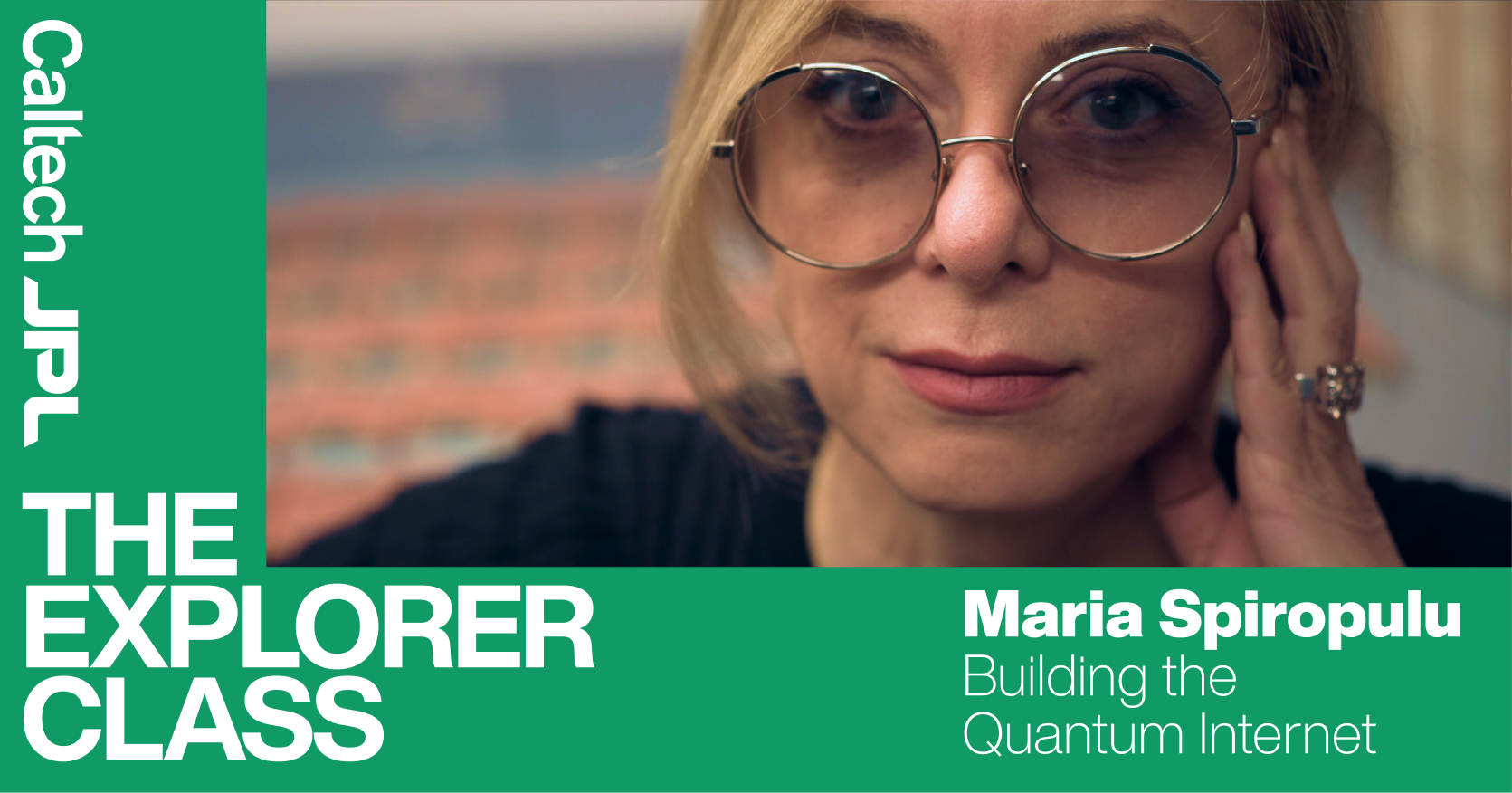
Credit: Graydon Manzke
This series of profiles highlights scientists, engineers, and innovators who have made Caltech JPL a center for American excellence.
by Lori Dajose (BS ’15)
Quantum computers are poised to revolutionize science, communication, and cryptography, spurring still unimagined advances in areas where classical computers hit fundamental limits. To build and scale this quantum future, we will also need to develop infrastructure to connect those powerful machines with each other and with their users: a quantum internet.
In June 2026, two executive orders issued by President Donald Trump outlined new priorities to accelerate American quantum technology development and the development of new approaches to cybersecurity in a "post-quantum" world. While the development and construction of a quantum computer have long been the primary focus of research and development, the executive orders placed equal importance on quantum networking and sensing technology.
Maria Spiropulu, Caltech's Shang-Yi Ch'en Professor of Physics, is a world-renowned leader in quantum networking: using the laws of quantum physics to connect quantum devices to each other, whether those devices are processors, sensors, or clocks. These networks offer security certified by physics rather than by mathematics, and timing that holds when GPS is jammed or unavailable.
“Quantum does not replace the science we do, it unlocks it,” Spiropulu says. “Sharper sensors find exoplanets and read their atmospheres. Better clocks hold navigation together when GPS is unavailable. Secure links carry the data back from deep space.””
The basic unit of information in a classical computer is a "bit" (or binary digit). Every bit can have only one of two states: a 0 or a 1. Quantum computers, in contrast, use "qubits" to carry out computations. Qubits hold a state of both 0 and 1 simultaneously in what is called superposition—a kind of combination of two states at once. A quantum computer uses these possibilities to carry out certain computations potentially much faster than any classical machine.
A quantum internet would also take advantage of the principles of an oddity of quantum mechanics called entanglement: a phenomenon in which two particles, although separated in space, share the same quantum state. Measure one part of an entangled pair, and the outcome for the other is fixed the moment the two results are compared, regardless of the distance separating them. Because any measurement disturbs the delicate entangled quantum state, the shared correlations cannot be intercepted or duplicated unobserved. This is the foundational principle behind quantum networks. By harnessing entanglement, researchers can build fundamentally secure communication systems that reveal any eavesdropping.
Spiropulu is working to turn these scientific principles into technological realities. As a particle physicist by training—she was part of the CMS (Compact Muon Solenoid) experiment at CERN's Large Hadron Collider when it announced the discovery of the Higgs boson particle, the so-called "God Particle," in 2012—Spiropulu's research leverages the unique connection between Caltech and the Jet Propulsion Laboratory (JPL), which Caltech manages for NASA, blending quantum science with the engineering that makes it work.
When working with individual particles, such as those at the heart of quantum computers, it is crucial to have highly sensitive detectors that can precisely measure changes in the states of each particle. Although JPL is perhaps best known to the public for its robotic space missions, such as the Mars rovers Curiosity and Perseverance, the lab is also a pioneer in developing detector technology such as superconducting nanowire single photon detectors (SNSPDs), the workhorses of quantum networking.
What is a Superconducting Detector?
A superconducting nanowire single-photon detector, or SNSPD, is a thin wire made of a superconducting material that twists and turns over a surface. The sensor is roughly the width of a human hair.
To operate the sensor, scientists hold the wire just below its critical temperature, typically around 1 to 2 degrees above absolute zero, while applying an electrical current slightly below the maximum current at which the material can sustain superconductivity. When a photon hits the wire, the wire absorbs the photon’s energy. This heats up a small area of the superconducting material and temporarily disrupts the superconductivity, locally increasing the resistance and creating a measurable voltage pulse. The pulse indicates that a photon has been detected.
JPL fabricates the quantum sensors used in the Caltech quantum-network testbeds, an optimized version of the detectors that read the laser signals from NASA's Psyche spacecraft beyond Mars. These signals are received at Caltech's Palomar Observatory in San Diego County, California.
(Text adapted from the National Institute of Standards and Technology)
Researchers at JPL and the National Institute of Standards and Technology (NIST) began developing superconducting single-photon detectors close to 20 years ago for reasons that had nothing to do with quantum networking. These detectors were originally used to capture signals from faraway spacecraft. JPL's Deep Space Optical Communications experiment sent the first laser communication link from deep space, and the detectors that received it are the same family used in the quantum-network testbeds on campus. In 2024, JPL's quantum sensors in California detected data from a laser sent over 350 million kilometers from the Psyche spacecraft, a NASA mission to probe an asteroid past Mars.
Now, researchers like Spiropulu are using JPL's detector technology to develop a functional quantum internet. In 2017, Spiropulu founded a research program at Caltech called INQNET (INtelligent Quantum NEtworks and Technologies), in collaboration with partners at AT&T, JPL, and the US Department of Energy's (DOE's) Fermilab in Illinois. With JPL's SNSPDs, the INQNET program built the quantum-network testbeds at Caltech and Fermilab, and the DOE now runs a portfolio of national quantum-network programs on that infrastructure. JPL's quantum team also works in the INQNET laboratories on the Caltech campus; students move between the two.
In work published in PRX Quantum in 2020, the team used the technology to teleport the quantum state of a photon across 44 kilometers of deployed fiber, with fidelity, the measure of how faithfully the state arrives, above 90 percent. Teleportation moves a quantum state rather than a message, and it needs an ordinary communication channel running alongside the entanglement.
The next step is to leave the physical fiber behind and make quantum connections through open air. INQNET and JPL are building a quantum link through open air between the Caltech campus and JPL, benchmarking its performance against fiber over the same route. The goal is a ground station that can hold a quantum link to a spacecraft, and a hybrid quantum internet running over both fiber and free space.
"Privacy, security, secrecy, will be the default," Spiropulu says. "We'll have a hybrid fabric between quantum computing and classical computing, and their associated internets. The quantum–classical hybrid will have a much higher capacity for discovery. It's a whole different animal."
"The executive orders ask NASA for a five-year plan for quantum sensing and networking in space," she adds. "The only operating precursor in the country is between this campus and this laboratory, and it has been running for years."

Jeff Kimble. Credit: Caltech
Did You Know?
The late Caltech physicist Jeff Kimble pioneered the field of cavity quantum electrodynamics, the study of single atoms trapped in cavities where they strongly interact with single photons of light. His experiments laid the foundations for research into quantum networks like the quantum internet. Kimble published a landmark paper about quantum connectivity in 2008.