
The Smartphone Camera Sensor Inventor: Protect America’s Tech Transfer Ecosystem
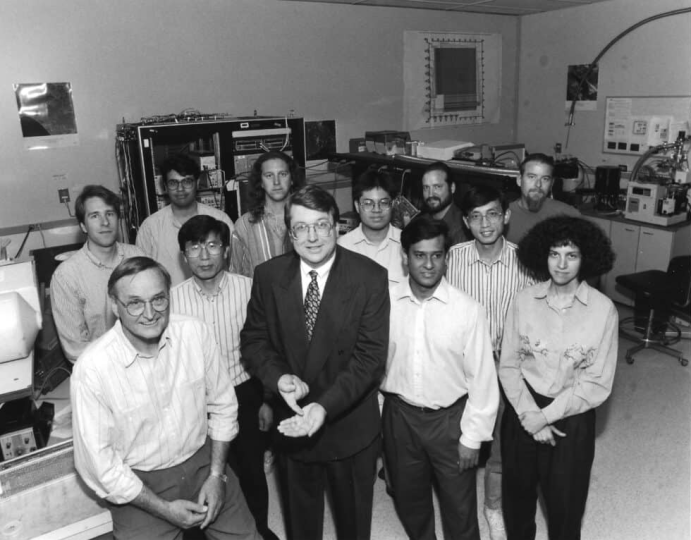
Eric Fossum’s team at JPL. Image: Caltech / JPL-NASA
by Andrew Moseman
The CMOS sensor, which enabled the world of smartphone cameras, autonomous vehicles, and webcams that we live in today, was born in a lab at the Jet Propulsion Laboratory, which Caltech manages for NASA. But the invention may never have left the lab if not for a key piece of federal legislation—one whose key structure could be changed by new federal policy.
Eric Fossum, currently a professor at Dartmouth College, was a researcher at JPL in the 1990s when he helped to lead the team that invented CMOS (complementary metal-oxide-semiconductor). As Fossum writes in a new op-ed for Fortune, they key to his invention’s success was the Bayh-Dole Act of 1980, which granted universities, research labs, nonprofits, and small businesses the ability to retain patent rights to creations that emerged from federally funded research, rather than having the government retain those rights. The act created a technology transfer ecosystem that has added trillions of dollars of value to the American economy.
Writes Fossum:
Proposed changes to federal research policy could make this system less predictable. For instance, one agency has proposed revisions to its financial assistance guidance that would give the agency a greater role in licensing patented inventions that benefit from its funding, rather than leaving those decisions to the institutions, as under Bayh-Dole. And a detailee at a federal research agency went even further, proposing that the Bayh-Dole framework be abandoned altogether.
Changes like these may sound procedural. But successful technology transfer depends on predictable rules. Researchers, universities, investors, and companies need confidence that the terms governing funding and intellectual property will remain stable throughout the long process of bringing an invention to market.
This video created by the Caltech Office of Technology Transfer and Corporate Partnerships explains the story behind the invention and how Caltech helped to bring the technology to the marketplace. Fossum’s team sought to improve the cameras that went aboard spacecraft when they created the sensor that now powers our world of digital imagery: