
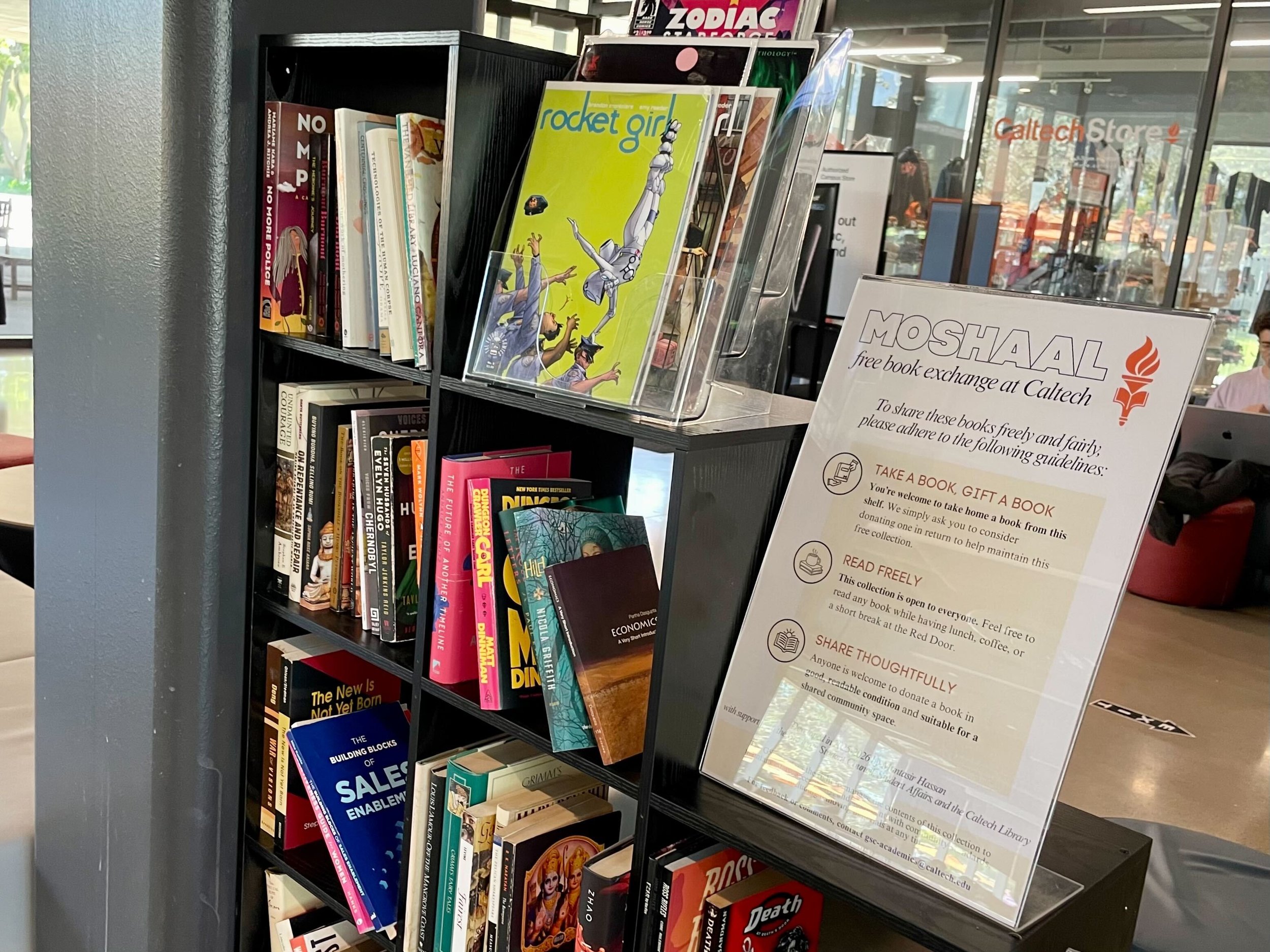
At Moshaal, located in the Hameetman Center, Caltech community members can take or leave a book to spread inspiration and knowledge to others. Credit: Sharon W. Tran
By Sharon W. Tran
In his high school years, fourth-year graduate student Muntasir Hassan often read a book per day. In 2025, however, deep into his PhD candidacy at Caltech, he read only two books during the entire year.
Hassan says his reading drop-off reflects the demands of his schedule more than any change in his love of reading, and that shift led him to ponder how to keep reading present in not only his life but that of his peers and community. Which is why, at a campus event in September 2025, Hassan approached Joseph Greenwell, then newly appointed associate vice president of student life, with an idea: to create an open library and book exchange hub for the campus community.
On March 1, 2026, just months after Hassan first pitched the idea, his vision officially opened to the public. Located in the Hameetman Center, between the Caltech Store and the Red Door Marketplace, the Moshaal book exchange hub—named for a Bengali word meaning “torch”—operates like a Little Free Library. Any member of the Caltech community is welcome to take a book and/or leave one for others to enjoy.
The project’s name came from a conversation between Hassan and his wife, Fariba Islam, who is currently pursuing a PhD at the University of Maryland, College Park. The pair met as undergraduates at the Bangladesh University of Engineering and Technology (BUET), where, with the help of some friends, they organized a similar open library project called Alokabartika. That word also means “torch,” but with a different nuance.
“As a word, ‘moshaal’ has an active component to it,” Hassan says. “While ‘alokabartika’ is the word for a light that illuminates what’s around you, ‘moshaal’ is a light that can be passed on from person to person.”
When Hassan told his wife about his book exchange idea for Caltech, Islam proposed the name of Moshaal. The term alludes to the official Caltech seal, in which two hands hold up a torch. Hassan says he hopes Moshaal will represent the light of knowledge passed through the books Caltech community members will share with each other.
Tending the Flame
After his initial pitch to Student Affairs, Hassan received support and guidance from the Graduate Student Council (GSC) to bring the idea of the open library to life. The GSC will serve as a steward for Moshaal; its members will regularly maintain the hub and check on the books to make sure they are in good condition and align with Caltech’s community standards. This will allow Moshaal to be maintained by the student body.
“We’re hoping to manage it in a way that allows it to persevere through time,” says Jedi Alindogan (BS ’23), a second-year doctoral student in control and dynamical systems and GSC Academics Committee co-chair. “In many ways, it reflects the Academics Committee’s broader goal of strengthening Caltech’s intellectual community—making knowledge more accessible, encouraging curiosity, and creating spaces where learning is shared and sustained by students themselves.”
For Alindogan, the opportunity to see what types of books the campus community will bring to Moshaal sparks the same type of curiosity that he felt when he used to shelve library books as a volunteer in high school. “I was always curious about what other people found interesting,” he says. “I’d see that someone was learning how to sew, or someone found a random romance about cowboys. There are so many stories out there, and I love it.”
“Caltech is a very special community with a lot of bright thinkers,” Alindogan adds. “Setting up an open library—especially at Caltech—means we can have a naturally curated selection of media, and I think that if someone in the community finds something especially interesting or good, I’d be surprised if it didn't appeal to other people here.”
Currently, Moshaal’s shelves can accommodate between 200–250 books, with the flexibility to add more space in the future if demand increases. Given its central location next to Red Door, Hassan also hopes the hub will naturally draw community engagement and grow alongside that interest.
“There is an idea from condensed matter physics that electrons always want to stay at their ground state or their lowest potential energy,” Hassan says. “To make an electron go from one state to the other, you have to create an additional state with a lower potential energy, so that it can jump through. Otherwise, it’ll get stuck in the same place. The idea is the same for humans as well. If you can create a lower path with less friction, then people are more likely to follow that path. I think we all go to Red Door once a day or once a week. The location of Moshaal reduces the barrier, so you can just cross the barrier and read a book.”
Moshaal was developed by Muntasir Hassan with support from the Graduate Student Council, Student Affairs, and the Caltech Library. For feedback and comments about the book exchange project,
contact gsc-academics@caltech.edu.