
by Andrew Moseman
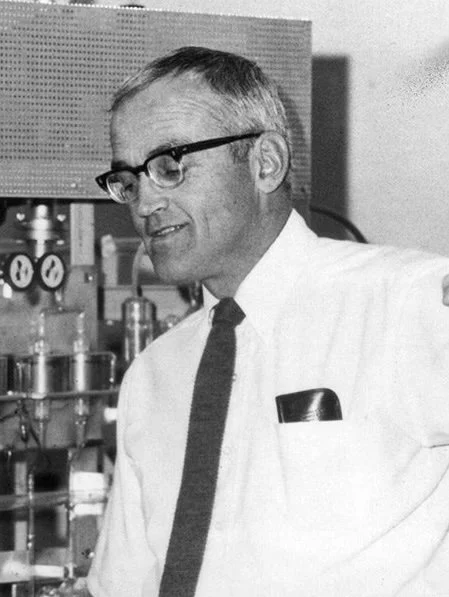
Clair Patterson. Image: Caltech
Although it had been widely used in gasoline, canned foods, and other consumer products, lead largely disappeared from our lives after the 1970s. That change was thanks to pioneering research by a Caltech scientist and new laws that came in the wake of the findings. Now, a new study in the Proceedings of the National Academy of Sciences (PNAS) uses hair samples to demonstrate just what an enormous difference the lead bans made to public health.
In the 1950s, Caltech geochemist Clair Patterson was trying to use lead dating to refine our knowledge of the age of the earth. It became an arduous project in part because Patterson found lead all over the place—and a lot more than should have been there naturally. In the end, he produced the modern estimate of the planet’s age at about 4.55 billion years by building one of the first contamination-proof “clean rooms,” and by carefully analyzing different lead isotopes. But the question of where all that lead was coming from in the first place piqued his curiosity. As Douglas Smith wrote for a Caltech feature in 2015:
His analytical skills had become so finely honed that he was finding lead everywhere. He needed to know the source of this contamination in order to eliminate it, and he took it on himself to find out.
Patterson's 1965 Environmental Health paper summarized that work. With M. Tatsumoto of the U.S. Geological Survey, he found that the ocean off of southern California was lead-laden at the surface but that the contamination disappeared rapidly with depth. They concluded that the likely culprit was tetraethyl lead, a widespread gasoline additive that emerged from the tailpipe of automobiles as very fine lead particles.
Leaded gasoline was invented in early 20th century as a chemical additive to prevent engines from knocking and was used for decades despite ongoing questions about its safety. The metal also went into the solder used to close the seams of food cans. Although the fact that lead is highly toxic to humans had been long known, Patterson’s research quantified, in detail, just how much lead the people of his time were being exposed to because of its industrial uses. As an Ars Technica piece about the new research in PNAS says:
He soon became a leading advocate for banning leaded gasoline and the “leaded solder” used in canned foods. This put Patterson at odds with some powerful industry lobbies, for which he paid a professional price.
But his many experimental findings on the extent of lead contamination and its toxic effects ultimately led to the rapid phase-out of lead in all standard automotive gasolines. Prior to the EPA’s actions in the 1970s, most gasolines contained about 2 grams of lead per gallon, which quickly adds up to nearly 2 pounds of lead released via automotive exhaust into the environment, per person, every year.
In this new research, University of Utah researchers studied human hair samples from people living in that state across a span of nearly a century. Utahans gave current hair samples and also supplied old ones from their youth. Some people even found and contributed hair samples that belonged to their ancestors. Hair isn’t the gold standard for lead exposure testing; a blood test is better. But the fact that hair can absorb lead from the atmosphere and does not lose it over time, combined with the endurance of hair samples, makes them ideal for a project such as this.
As the Ars Technica article explains:
The authors found very high levels of lead in hair samples dating from around 1916 to 1969. But after the 1970s, lead concentrations in the hair samples they analyzed dropped steeply, from highs of 100 parts per million (ppm) to 10 PPM by 1990, and less than 1 ppm by 2024.