
Turning Up the Heat to Save a Jupiter Mission
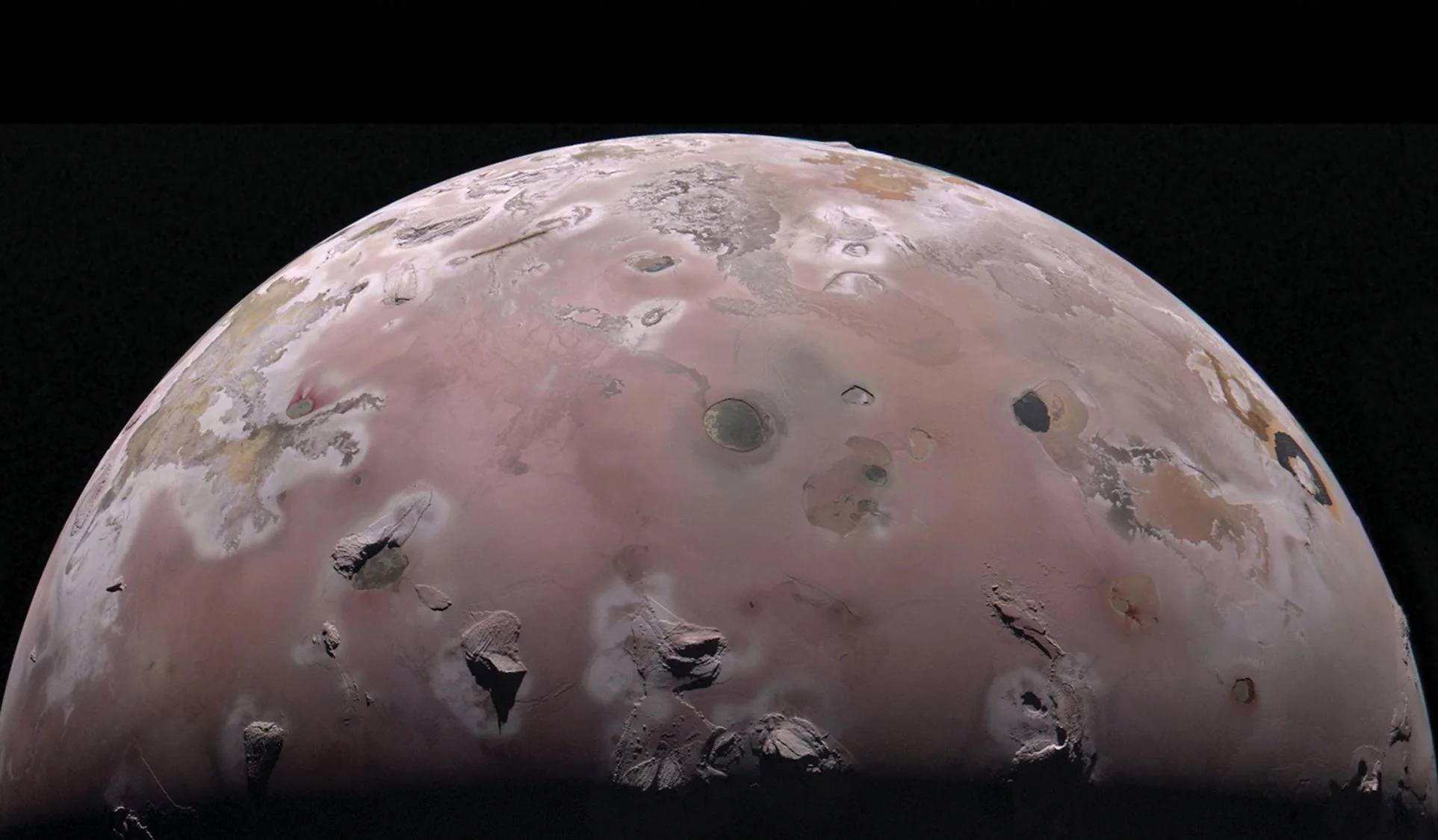
Jupiter’s moon Io, as photographed by the Juno spacecraft’s JunoCam on December 30, 2023. Credit: Image data by NASA/JPL-Caltech/SwRI/MSSS, Image processing by Gerald Eichstädt.
In November 2023, NASA’s Juno spacecraft was a month away from its closest encounter yet with the surface of Jupiter’s moon Io. Coming within roughly 930 miles of the most volcanic world in our solar system, the orbital pass would allow Juno’s instruments to generate a firehose of data about variations between Io’s volcanoes.
There was only one problem: Juno’s camera, known as JunoCam, had stopped working. By the spacecraft’s 55th orbit on November 22, 2023, nearly all of JunoCam’s visible-light color images had been corrupted by Io’s radiation. The problem, the team knew, would only get worse as the spacecraft flew deeper and deeper into the heart of Jupiter’s radiation fields.
“Our images were full of streaks and noise,” says JunoCam instrument lead Michael Ravine of Malin Space Science Systems. The Juno mission is managed by JPL, which Caltech operates for NASA. “We tried different schemes for processing the images to improve the quality, but nothing worked. With the Io close encounter bearing down on us in a few weeks, it was Hail Mary time.”
The JunoCam images began to show hints of radiation damage during orbit 47. The team then tried heating the camera as part of a process called annealing, in which a material is heated for a specified period and then slowly cooled. The idea is that heating can reduce defects in the material. New images initially turned out crisper, but the damage soon returned. “The only thing left we hadn’t tried was to crank JunoCam’s heater all the way up and see if more extreme annealing would save us,” Ravine says.
Test images showed little improvement the first week. Then, with the close approach of Io only days away, the images began to improve dramatically. By the time of the crucial pass on December 30, 2023, the images were almost as good as the day the camera launched. They captured detailed views of Io’s north polar region that revealed mountain blocks covered in sulfur dioxide frosts rising sharply from the plains and previously uncharted volcanos with extensive flow fields of lava.
Since the experiments with JunoCam, the Juno team has applied variations of the annealing technique to several Juno instruments and subsystems. “Juno is teaching us how to create and maintain spacecraft tolerant to radiation, providing insights that will benefit satellites in orbit around Earth,” says Scott Bolton, Juno’s principal investigator from the Southwest Research Institute. “I expect the lessons learned from Juno will be applicable to both defense and commercial satellites as well as other NASA missions.”