
How to Build a Better Battery
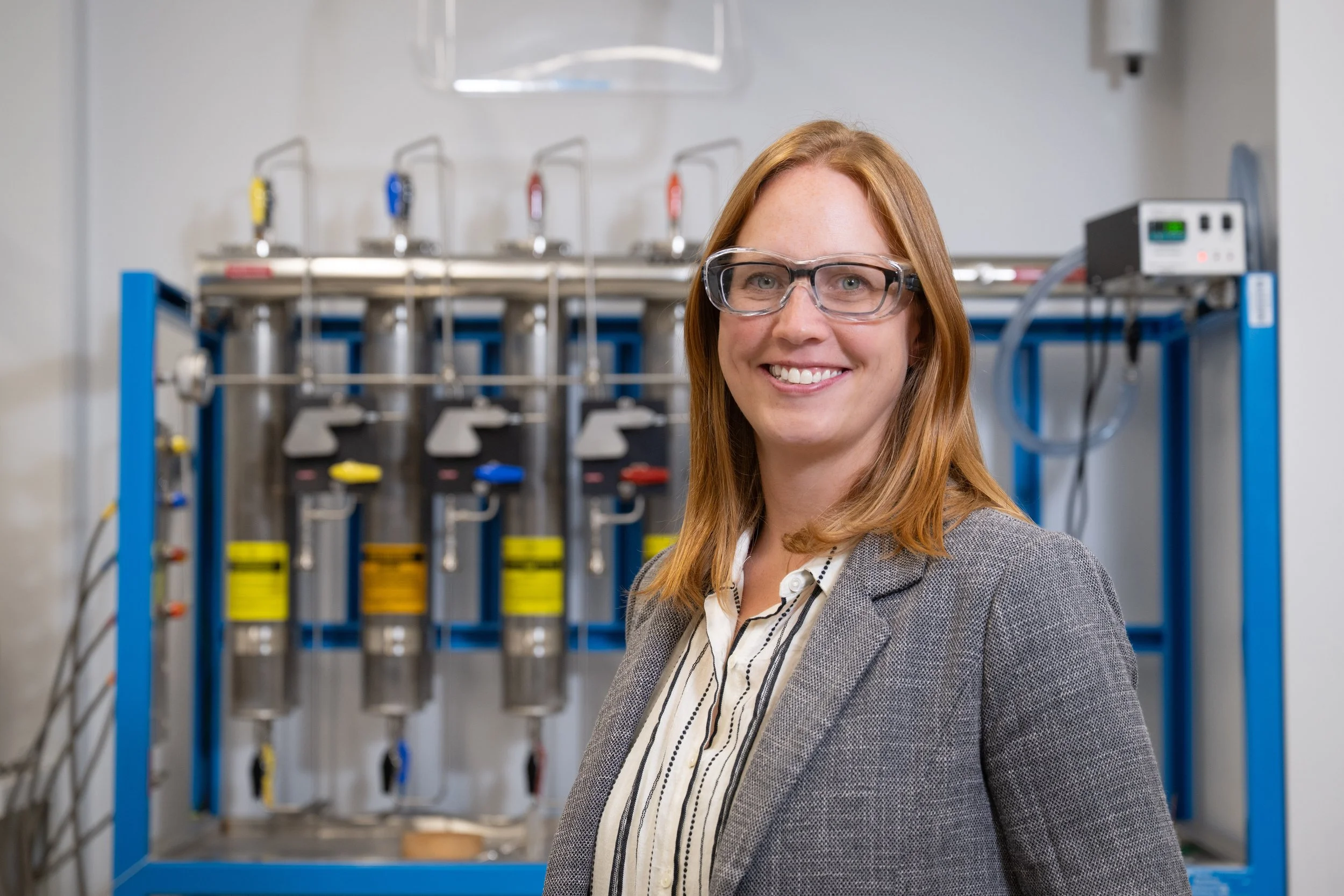
Kimberly A. See, Professor of Chemistry. Image: Lance Hayashida for Caltech
by Sabrina Pirzada
Lithium-ion batteries are embedded in modern life, powering our phones and laptops, EVs, power tools, vacuums, and lawnmowers. Our large-scale energy-storage systems rely on them too, as they support our electrical grid and the data centers that power AI. But a turning point is approaching: Lithium-ion batteries need rare materials like cobalt and nickel, and building batteries to meet exponentially growing energy demand requires more of those metals than the earth can readily supply.
“In order to power the AI boom, we need things like data centers, which require a massive amount of energy. This number is starting to look exponential,” said Kimberly See, professor of chemistry, in her Watson Lecture on the future of battery technology. “The energy needed to power one data center is enough to power 100,000 to 2 million homes. And by the year 2027, we could see 12 percent of US electricity consumed by data centers. That number should make you gasp. This problem is only getting harder.”
To meet this challenge, See and her collaborators at Caltech are working toward batteries made of much more abundant materials.
Ask What Your Battery Could Be
When thinking about the energy-storage technology of the future, See starts by deconstructing what a battery even is. “The first rule that you need to know is that energy cannot be created or destroyed, but it can be converted. That’s what batteries do. They convert chemical energy to electrical energy,” she explained to a crowd of almost 700 attendees. From that perspective, everything else becomes a design question. Where will the energy be stored? How will it be moved? What are the limits to how much can be held?
Here is how See breaks down the challenge: The composition of a battery includes two reservoirs [the anode and the cathode], which she calls “buckets,” separated by a barrier. Electrons flow from one side to the other, delivering energy while ions move internally to keep the system balanced. The amount of energy stored within the battery depends on two variables: how far apart in energy those buckets are, which controls the voltage, and how much each one can hold, which decides the battery’s capacity. “The energy is just the product of the capacity times the voltage,” See said.
That is the core trade-off that governs the chemistry of batteries. Thus, building a better battery requires raising the voltage, increasing the capacity or, ideally, both. Yet each of those moves is constrained by the materials involved.
Start with What the World Has
For future batteries to meet global demand for electric vehicles, grid storage, and more, they must be built from materials that are widely and indefinitely available. This constraint greatly narrows the possible choices.
Iron is one strong candidate, specifically for the cathode. “Iron is a metal that’s found all over the world, and we already have a way to mine it and produce it in quantities and purities that would allow us to make these materials,” See said. Unlike cobalt or nickel, iron is not limited in supply.
Find the Lever
Choosing new materials also introduces new constraints. For example: Iron, for all its advantages, operates at a lower voltage than the metals used in conventional lithium-ion batteries. This leads to a less powerful battery unless something else changes. So, the design becomes a balancing act: If one parameter goes down, another must go up. Rather than trying to push iron beyond its natural limits, the strategy becomes about finding ways to store more charge within the same system to offset the lower voltage.
In conventional materials, charge is stored on the atoms of the metal alone, but the metals are only part of the structure. What if the surrounding atoms—the anions, like sulfur or oxygen, which make up the rigid scaffolding the lithium ions travel through—could store charge too? See and her team have demonstrated, through a process called anion redox, that they can. When anions participate in the electrochemical reaction, the cathode gains access to a second reservoir of charge, significantly increasing the capacity of traditional materials. The result is a material that does more with the same ingredients.
However, this approach also introduces instability. Metals tend to handle the gain and loss of electrons cleanly, returning to their original state cycle after cycle. Sulfur, a common anion, does not. When its electrons are removed, it becomes unstable and begins to reorganize, forming new bonds with neighboring atoms. Designing around that behavior becomes part of the solution carried forward through a deliberate research loop that involves building, testing, and analyzing results in order to transform incremental discoveries into reliable chemistry.
“We make the materials; we fill and empty the buckets, and then we go back and figure out what happened,” See said. “There are a few things on the table that could change our ability to use batteries and change their application and how we use them. This fundamental understanding is the cornerstone on which we can build the next best thing.”
Look Beyond the Horizon
What happens when a battery can be designed around sodium, magnesium, or zinc—elements that are more abundant and, in some cases, capable of carrying more charge? These are not hypotheticals for See: Her lab is actively investigating all three as part of a broader push beyond lithium. The future of batteries will expand on what is possible across materials, mechanisms, and design, beginning in the lab where new chemistries are understood before they are built. Our increasingly electrifying future will require abundant energy storage, and investigations such as See’s, that delve into fundamental chemistry, will help get us there.
This article was adapted from Kimberly See’s February 2026 Watson Lecture. Watch the full lecture below, or on YouTube.