
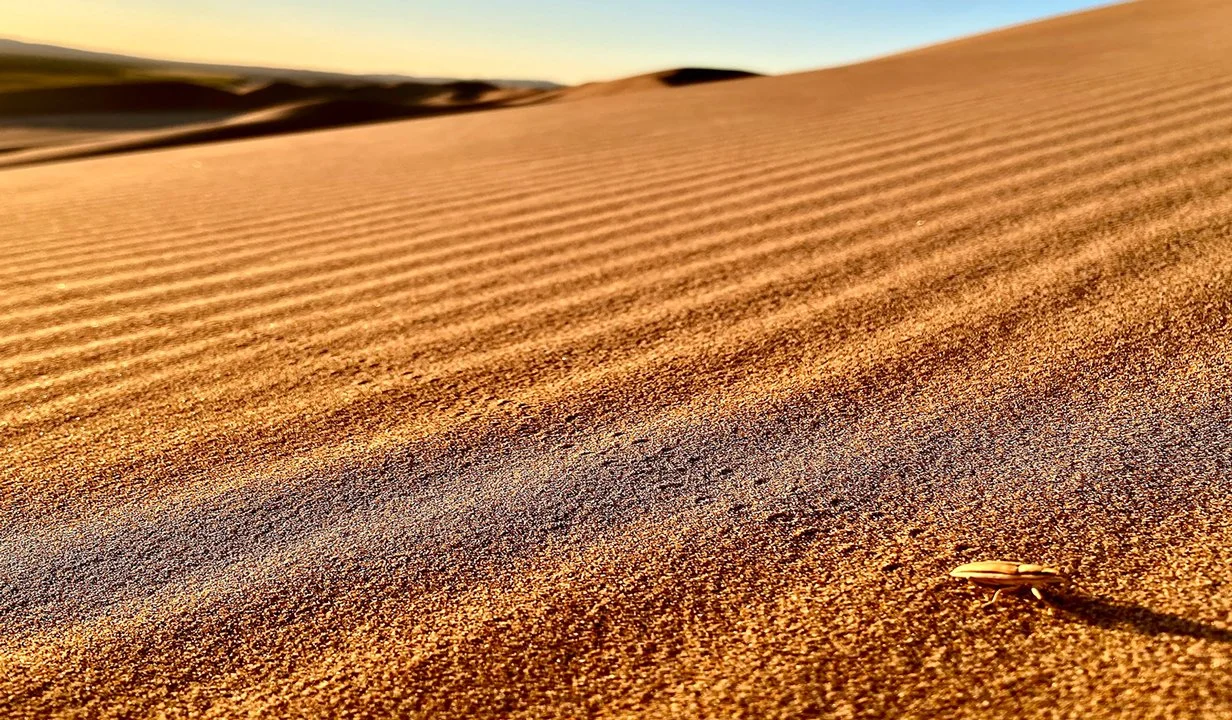
Credit: Claire Bucholz
Field trips, even those not centered solely on research, are a core element of instruction in Caltech’s Division of Geological and Planetary Sciences (GPS). The division offers all graduate and undergraduate GPS students the opportunity to attend one enrichment trip during their time at the Institute. These excursions, which are funded by philanthropic donations, typically occur annually and are designed for students to bond while exploring a country’s geography and taking part in cultural experiences.
“Enrichment trips are truly a special part of the division,” says Claire Bucholz, professor of geology, who led the August 2025 trip to Mongolia, which included a visit to the country’s Flaming Cliffs to look at dinosaur fossils, as well as a tour of the Oyu Tolgoi porphyry copper-gold mine, among other activities.
Typically, graduate students come up with a plan for which country or countries to visit and sketch out the itinerary. Then they recruit two faculty or staff members to go along. Past trips have ventured to Alaska and Canada, Iceland, and New Zealand. “We have atmospheric chemists, sedimentologists, planetary scientists all getting together and going on this big adventure,” Bucholz says. “The insights from different parts of the division and the connections and the relationships you build are really important. On this trip, we were fortunate to have five graduate students from Mongolia with us with whom the Caltech students quickly became friends and learned so much from.” The photo above was taken just after sunrise at the Khongoryn Els dune field, the largest in the Gobi Desert, where the Caltech group stayed in gers, or traditional Mongolian circular dwellings.
“I got up early and wanted to get to the sand dunes for the sunrise,” Bucholz says. “I was looking out at these really impressive macroscopic features, but you could also see the little ripples on the surface, which show you the direction of more recent wind transport. Then there was this little beetle walking across, so it caught my eye as an interesting juxtaposition of biology and geology.”