
Composite by Jenny Somerville.
How Caltech researchers blend fields and scientific approaches to achieve results.
By Ker Than
Theoretical physicist Kathryn Zurek has dedicated much of her professional life to trying to solve the riddle of the universe’s missing mass, also known as dark matter. In her view, dark matter could be far richer than many theorize—not a single particle but an entire “shadow world” with its own variety of particles and forces.
Her proposal fits within the standard model of particle physics, but condensed matter theorists she conferred with initially struggled to see how it connected to the problems they were interested in. “Even among theorists, people have very different ideas about what’s worth pursuing, and they build tools around the questions they care about,” she explains. “If you’re asking a question that’s just slightly off that well-trodden path, it can be difficult to extract the answer.”
While theorists can disagree on lines of questioning among themselves, the difficulties are often amplified during collaborations between experts from different disciplines, or between theorists and experimentalists.
But Omer Tamuz, a Caltech professor of economics and mathematics, says this heavy lifting breeds strong interdisciplinary research at a place like Caltech. “Our job is to explain why our work is interesting” to experts trained to care about different things and who have their own language, norms, and expectations about how assertions should be framed and considered, he explains.
It takes great effort to push insights across scientific boundaries, but when those who think about or see the world differently figure out how to work together effectively, the breakthroughs can be beautiful. Recognizing that the Institute can play a role in sparking these budding partnerships, Caltech has built its culture, teaching philosophy, and even parts of its campus, to facilitate these interactions. “We have to build these cross-disciplinary bridges and collaborations,” says Sergei Gukov, the John D. MacArthur Professor of Theoretical Physics and Mathematics.
The Language Barrier
In conversations with condensed matter theorists physicists who study the properties of materials like crystals and superconductors—Zurek, the Louis E. Nohl Professor of Theoretical Physics, kept posing questions that fell just outside of what their field’s tools were designed to tackle.
The turning point came when she stripped dark matter out of the conversation almost entirely. Instead, she described the problem in terms of quantum mechanics—a language shared by all physicists. When Zurek and her theorist colleagues began discussing dark matter not as a specific particle but rather as a generic probe that deposits energy and momentum into a system, the problem narrowed to calculations and other mathematical tools commonly used in condensed matter physics. “Once you’re able to ask the right question in the right way of the right people, you’ve already won a significant part of the battle,” Zurek says. “At that point, you can unlock and take advantage of all the resources in a field.”
The disciplinary divide becomes particularly evident when it is time to turn ideas into papers, Tamuz says. That is because no matter how interdisciplinary the work, the paper itself has to pick a side. “When you write a paper, it’s either a math paper or an econ paper,” he says. This is notable because each field evaluates research findings differently. “You have to understand the culture to get your papers published or risk dismissal due to ‘too much math’ or ‘not enough economics.’”
So, Tamuz learned to code switch, reframing abstract ideas so economists not as concerned with math can see why those concepts and calculations matter. It is a beneficial skill, he says, because it forces him to explain what a theory actually predicts about the world rather than just what it proves mathematically.
Gukov says some of the challenges to finding connections between his mathematics and physics research, as well as between subfields within mathematics, are more about translation than synthesis. “It’s a language barrier,” he says. “It’s no different from French and English.”
Early in his career, Gukov helped develop what became known as the Gukov–Vafa–Witten superpotential, a type of mathematical function used in quantum physics. This work became an important tool in string theory, one that drew on different branches of mathematics to address a technical problem concerning the shape and structure of hidden extra dimensions. Later, physicists realized the tool could help explain why string theory allows so many possible universes—and why one like ours, with properties seemingly fine-tuned for life, might number among them.
Gukov says the ability to bridge fields, as he has done with math and physics, and more recently with math and computer science, cannot be done through intuition alone. It can take years to learn another discipline well enough to understand which problems it already considers solved, which questions it deems trivial, and where the knowledge gaps lie. “Graduate students accept being beginners and put in the sustained work to master new fields,” Gukov says. “So, we really have no excuse not to master a new field as professionals.”
This process has required slow and unglamorous work: reading unfamiliar literature, absorbing seemingly arbitrary conventions, and most importantly, learning not to label yourself as only a certain type of scientist, Gukov says. During a visit years ago with mathematician and Fields Medalist Michael Atiyah, Gukov began outlining how he planned to approach a problem “as a geometer.” Atiyah cut him off. “Consider it from all perspectives, from the point of view of geometry, algebra, physics, etc.,” Atiyah told him.
Gukov took it to heart. Now, when people ask him what he does, he answers, “I love building bridges.”
A Foot in Both Worlds
In the late 1950s, Rudy Marcus proposed an idea that seemed to break a basic rule of chemistry. According to his theory of electron transfer, pushing a reaction harder would not always make it go faster. Indeed, after a certain point, it should actually slow down—a breakthrough that came to be known as the inverted region and helped earn Marcus the 1992 Nobel Prize in Chemistry.
Confirming this theory took nearly 25 years because the experiments were extraordinarily difficult to build. The effort required chemists to combine their talents “to construct systems where some of the things that were preventing one from seeing the inverted region were absent,” says Marcus, the John G. Kirkwood and Arthur A. Noyes Professor of Chemistry, who came to Caltech in 1978.
Theoretical research, he argues, requires discipline and detachment. “It’s desirable not to get stuck on an idea simply because you thought of it,” he says. “If it doesn’t look good, forget it. Try something else.” But you also have to know when to hold firm. Marcus is matter of fact about why he never wavered on his inverted-region prediction. “As long as the conditions on which it was based were met,” he says, “I felt the prediction was right.”
Marcus, who celebrated his 102nd birthday in July 2025, began his career as an experimental chemist. But during his time as a postdoc at the National Research Council of Canada, he and a friend started a two-person seminar, reading theoretical papers to each other weekly to teach themselves what no one around them could. In chemistry, theory helps researchers understand patterns, explain observations, and predict future results. “I thought, this is more interesting than the experiments I’m doing,” Marcus recalls.
Even after becoming known as a theorist, Marcus continued to use what he calls “physical intuition”—thinking in physical rather than abstract terms. “I really had no problem interacting with experimentalists, and a number of times their experiments were the basis of my working on a particular problem,” he says. “The important thing is to keep an open mind and not remain focused on one thing.”
That perspective helped shape his openness to computational chemistry, which was still relatively new when Marcus began engaging with it in the 1960s. The approach offers a new way to think of experimentation: The computer simulations used in this field are, essentially, mathematical and physics-based models that can predict the results of lab experiments before they have taken place, offering insights into molecular structure and behavior.
Caltech’s Rudolph A. Marcus Center for Theoretical Chemistry, which launched in 2024, institutionalizes this computational approach to the field. Thanks to a gift from Drs. Jack Yongfeng Zhang and Mary Zi-ping Luo, both former Caltech postdocs, the center offers fellowships as well as research funding, and it hosts meetings and workshops for researchers from across the country to exchange ideas and foster new collaborations in theoretical chemistry.
For Garnet Chan, the center’s director, computation goes hand in hand with theory, so the center’s goal is to bring these efforts together. “In chemistry, what people call theory and what people call computation are often just different pieces of the same process,” says Chan, a Bren Professor of Chemistry. “You write down equations, and then you have to find ways to solve them—and those ways involve computation. It’s all kind of the same thing.”
When Chalk Meets Bench
The decades it took to confirm Marcus’s theory of electron transfer highlight an asymmetry between theory and experiment. While a theorist can abandon an idea by wiping a chalkboard clean, an experimentalist often commits years of labor, specialized equipment, and grant funding before learning whether an idea holds. This often makes experimentalists more cautious before investing in an idea. For experimental physicist Rana Adhikari, deciding whether to pursue a theoretical idea begins with trying to break it. “I always ask: What would disprove your theory?” says Adhikari, a longtime member of the LIGO (Laser Interferometer Gravitational-wave Observatory) team. He presses theorists to name specific observable outcomes that would rule out their ideas. “If there’s nothing that could disprove it, then it’s not science.”
When a theory survives that first cut, Adhikari and his collaborators often review decades of prior experiments to determine whether the idea has already failed without their knowledge. “Half the time, you find someone did the experiment in 1975,” he says. “Then you write it down and move on.”
It took Adhikari plenty of time and effort to recognize the importance of this dialogue. When he first arrived at Caltech as a postdoc in 2004, the divide between theory and experiment felt like a source of constant friction for him. “I thought, why doesn’t everyone just handle everything themselves?” he says. “Figure out the engineering, figure out the math, and we’ll all be the same!”
He would often get hung up on details that made it hard for him to find common ground with theorists. He recalls a particular conversation about a proposed experiment to build a continental-scale quantum network. “I’d ask, ‘Why does t stand for frequency and f stand for time?’” he recalls. “Everyone uses t for time.”
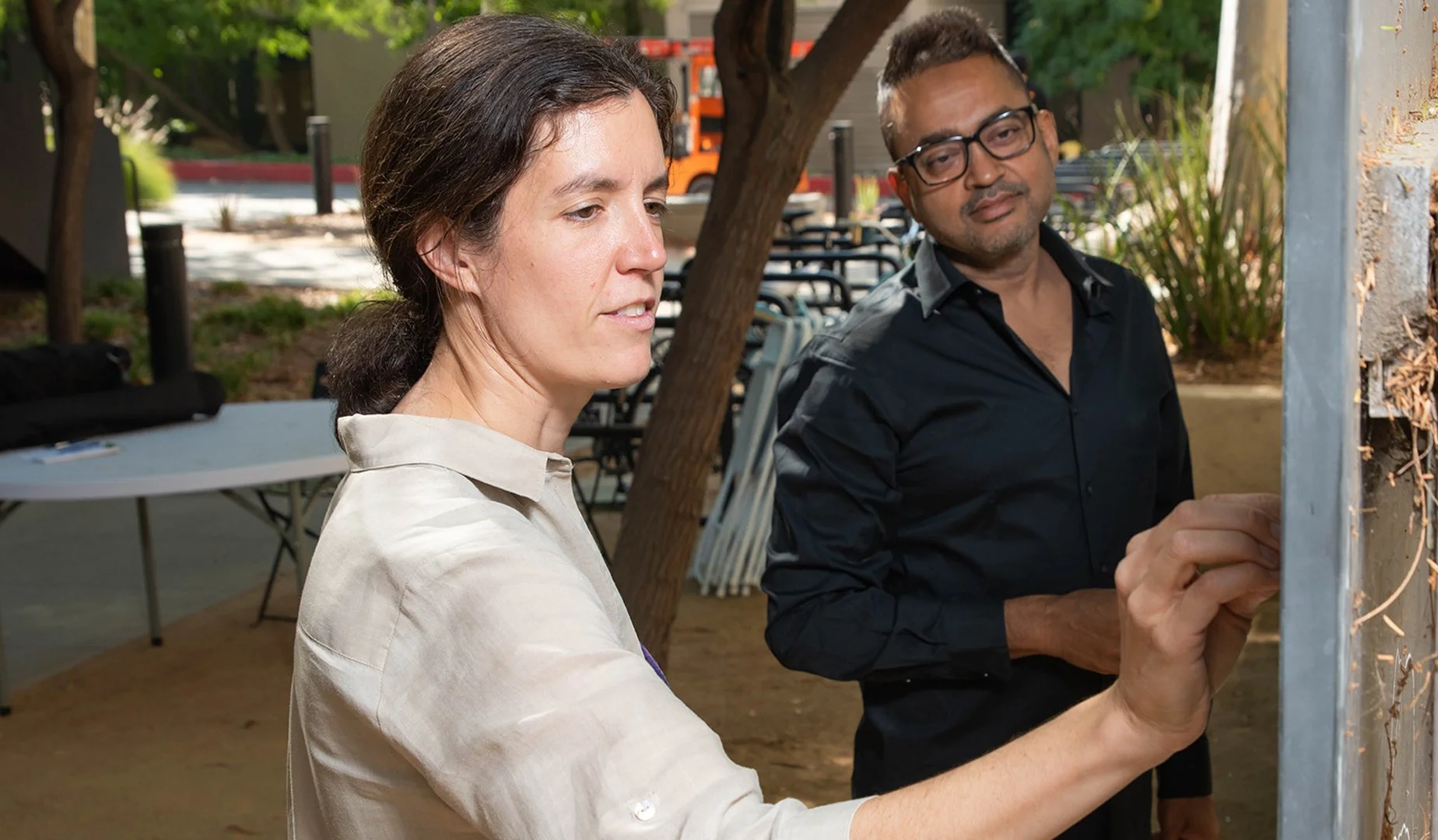
Kathryn Zurek, left, and Rana Adhikari at a blackboard near the Moore Lab of Engineering. Credit: Lance Hayashida.
Adhikari’s stance eventually softened in part due to a friendship. When Adhikari and Yanbei Chen (PhD ’03), a Caltech professor of physics, met at the Institute in the mid-2000s, they formed a partnership that shaped both their careers. The two worked closely and traveled together, spending long stretches talking through problems and gradually absorbing one another’s way of thinking. “I believe he’s way more interested in experimental physics because of me,” Adhikari says. “And I know so much more theoretical physics because of him.”
Adhikari says he now realizes that nascent ideas are fragile and should not yet be subject to real-world stress tests. “It’s like a little bird in a nest,” he says. “At the beginning, you have to work in that ideal world where everything is mathematical and simple. I now like to avoid anything negative at that point that could break it.”
Today, the two sometimes work together at the LIGO control room in Livingston, Louisiana, where Adhikari sits at the console making minute adjustments to an instrument designed to measure ripples in space-time smaller than a proton. Alongside him, Chen watches the readouts, talking through the physics as the experiment responds in real time.
Adhikari jokes that it can feel like having a backseat driver, but it works. Chen understands the experiment’s constraints without becoming overwhelmed by day-to-day details. “They don’t have screwdrivers in their world,” Adhikari says of theorists. “They throw away a lot of these engineering constraints that we have, and they’ll come up with ideas we would never get to because we’re always thinking, ‘I can’t fit a wrench in there.’”
During a recent discussion about a gravitational-wave detector design, Chen corrected how Adhikari was describing the motion of a mirror by adding a mathematical term to properly account for relativity, replacing Adhikari’s more simplified description. “I was like, ‘Why are you nitpicking right now?’” Adhikari recalls. Only later did Adhikari realize that the correction forced a fundamental rethinking of the mirror system. “Most of us, when we think about Einstein and gravity, we ignore these tiny corrections,” Adhikari says. “It’s really just the theorists who think about it.” But that 0.1 percent correction opened a new possibility: measuring space-time itself without worrying about the actual motions of objects on Earth. The insight led to the publication of a series of papers in Physical Review Letters.
Adhikari and Chen’s collaboration stems from a practice that LIGO co-founder and Nobel Prize winner Kip Thorne, the Richard P. Feynman Professor of Theoretical Physics, Emeritus, established in the 1960s, requiring his most mathematically inclined students to spend a full year working alongside experimentalists. “Apparently, there was a lot of kicking and screaming among the students,”
Adhikari says. “They’d say, ‘I came here to study Einstein, not rubber gaskets.’” But some of those same students went on to make consequential contributions to materials and mechanics—gritty details that can make or break an experiment.
Chen, one of Thorne’s last students, absorbed that ethos. Adhikari now mirrors it from the other direction, sending his own experimental students to spend weeks embedded in Chen’s group. “The issue is too sophisticated to be able to do it in a lunchtime conversation,” he says. “They have to sit over there and live in it for a while, then come back and translate it into our world.”
Sometimes the exchange of thoughts and ideas runs even deeper. When Haixing Miao, then a visiting student in one of Adhikari’s classes, designed a magnetic levitation system that looked elegant from a theoretical point of view, Adhikari was not convinced it would work in practice and challenged him to prove it. “People told me I was nuts for doing that,” Adhikari says. Then, when Miao later returned to Caltech as a postdoc, he took Adhikari up on it. What surprised Miao most was the lead time involved in experimental work. “In theory, you can move very quickly, and most things are under your own control. In experiments, that is not true,” he says. “You depend on other people, on equipment, on parts, on machining, on delivery times, so planning becomes extremely important. A bad plan can easily cost you a lot of time and slow the whole project down. Rana was the steering wheel that pushed me back on track.” Two years later, Miao had what he called a “successful proof of principle,” a working levitation system that could suspend a test plate with multiple degrees of freedom.
He came away with a recalibrated sense of the distance between theory and reality. “A lot of the simplifications you make in theoretical analysis are not always justified in practice,” says Miao, who is now an associate professor at Tsinghua University in China. He splits his time evenly between theory and experiment, and continues to refine the magnetic levitation system with his students. “That experience changed the way I think about physical systems.”
People like Miao are rare, Adhikari says. “They’re like switch hitters in baseball.”
One Lab, Two Methods
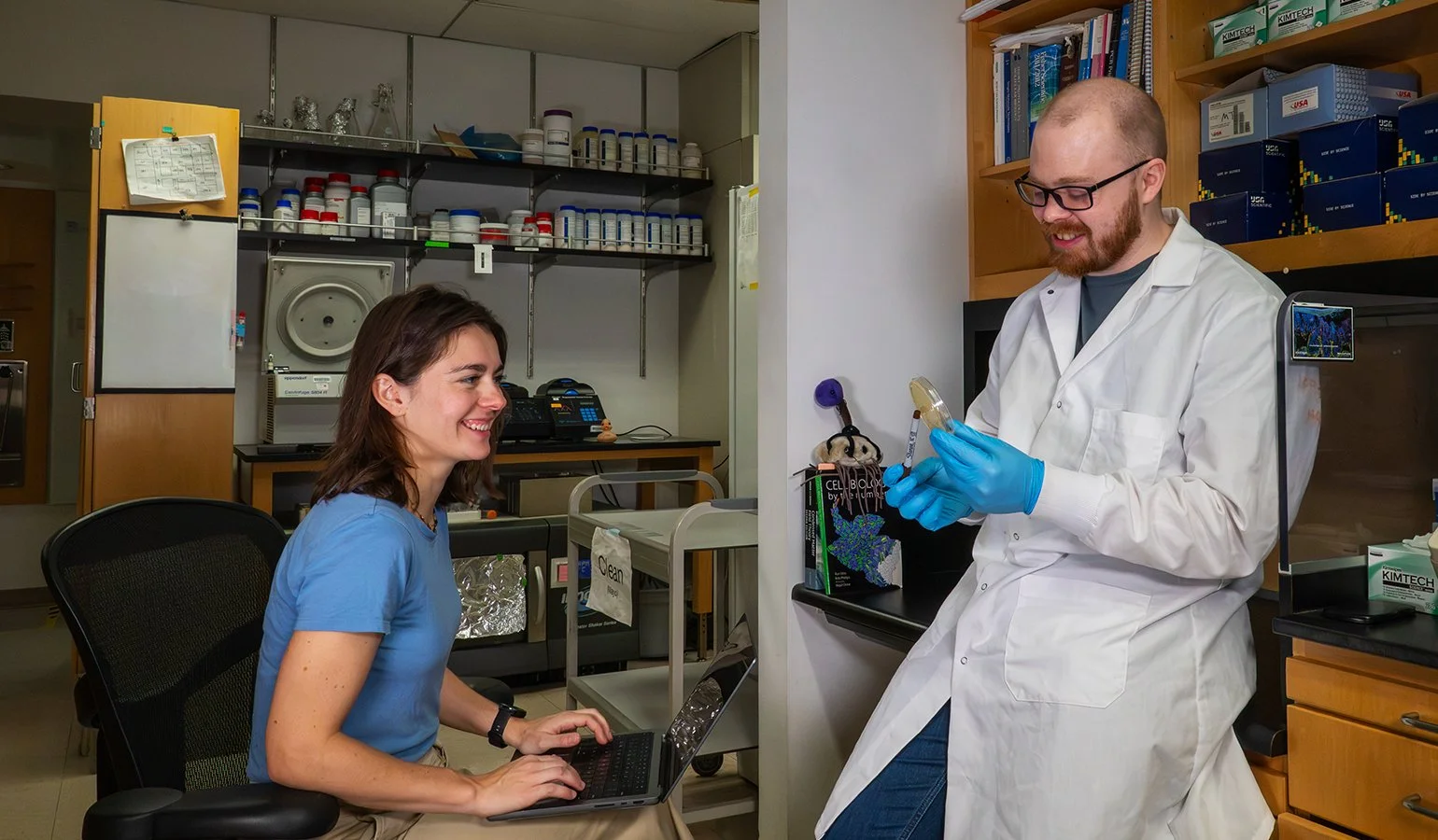
Theorist Sara Mahdavi, left, and experimentalist Tom Roeschinger are graduate students in the lab of Rob Phillips. Credit: Sergio Solorzano.
One of Caltech’s own “switch hitters” is Rob Phillips, the Fred and Nancy Morris Professor of Biophysics, Biology, and Physics, who has built a lab in which theory and experiment are integrated from the start. His group aims to “mathematize” biology by combining mathematical models with empirical work to turn biological observations into precise testable claims rather than after-the-fact explanations.
For Phillips, separating theory and experiment has never made much sense. “Science cannot progress with either experiment or theory alone,” he says. “In my lab, it’s expected that there’s a dialogue between them, and we never ever forget that or pretend that there’s not.” He compares developing fluency between the two to learning to surf. To a novice, waves appear chaotic. To an experienced surfer, they are legible: a secret language inscribed on water by wind, tide, reef, and current. “An observer who has never surfed has zero concept of all the things that are going on,” he says. Good science, in his view, works the same way: Theory teaches you how to read the system; experiment reveals which intuitions hold up and which ones do not.
This worldview shapes how Phillips trains students. His experimentalists learn theory by deriving equations with him on the white board. His theorists, meanwhile, are expected to build instruments—and not just once, Phillips says. “You need to solve that differential equation 30 times. You need to build a microscope 20 times. It needs to be second nature no matter who you are.”
After meetings with Phillips, experimental students sometimes follow up with a two-page walk-through of a mathematical argument. Phillips typically sends these back covered in notes and new equations. The idea is that designing good experiments requires theoretical insight, and making serious theoretical claims demands an understanding of what instruments can and cannot measure. This leads to models with as few unknown parameters as possible, which form the basis for what Phillips calls “dangerous predictions,” meaning ideas that are precise enough to either fail or succeed in experiments. “You don’t get to come back later and say, ‘Oh, I forgot this parameter,’ or ‘We can tune this knob to make it work.’”
Converging by Design
None of this openness to switch hitting is new at Caltech; the Institute has a history of researchers who refused to treat theory and experiment as separate domains. Physicist and Nobel Laureate Richard Feynman moved freely between abstraction and hands-on work, from quantum electrodynamics to wet-lab studies of viruses. Physicist George Zweig (PhD ’64), best known for the quark model, also ran his own biological experiments as a professor, studying auditory processing in cats. Chemist and Nobel Laureate Linus Pauling (PhD 1925) pioneered quantum mechanical theories of chemical bonding as a professor at Caltech, where he also directed research at the Gates (now Gates–Thomas) and Crellin laboratories.
And these sorts of intellectual mergers are not limited to the natural sciences. The philosophy behind them can also be found in the Division of the Humanities and Social Sciences’ Center for Theoretical Experimental Social Science (CTESS), where theorists and experimentalists work together from the outset, and students move between theory- and behavior-based seminars.
“A lot of the theories that economists write can be tested in a very controlled setting,” says Marina Agranov, the Rea A. and Lela G. Axline Professor of Economics, who directs CTESS, a part of the Ronald and Maxine Linde Institute of Economic and Management Sciences. “If this theory fails in this very controlled environment in my experiment, we don’t have any hope that it’s going to hold in reality, which is much, much more complicated.”
Interaction can also be promoted by conscientious physical design. For example, a pedestrian bridge under construction as of April 2026 will connect the forthcoming Ginsburg Center for Quantum Precision Measurement to the Downs-Lauritsen Laboratory of Physics, thereby linking quantum information and condensed matter theorists with high energy physicists. The bridge exists because the faculty pushed for its inclusion, says Zurek, whose office sits in Downs-Lauritsen.
“Physical access matters,” she explains. “If you have to go from the fourth floor down to the ground floor, walk across, and then take an elevator back up to the third floor of the next building, you’re much less likely to interact than if you can walk down the hall through the bridge.” For Zurek, the bridge acknowledges how science actually happens. Reducing friction changes behavior and leads to conversations. “That’s a fact of physical embodiment,” Zurek says.
Phillips agrees with Gukov that Caltech’s small size plays a role by fostering playful, productive dialogue. “There’s a sense that you’re allowed to try things, to engage across boundaries, and to take ideas seriously without deciding in advance where they belong,” he says.
Chan, meanwhile, relishes that Institute faculty members encounter one another constantly, students move freely between groups, and disciplinary labels matter less than the problems people want to solve. “In some sense,” Chan says, “we’re all just working with friends, people to whom you don’t feel ashamed to say, ‘I didn’t understand the first line,’ and who then help you understand what you didn’t get. That matters.”