
Fume Hood Student Sustainability Project Saves Thousands
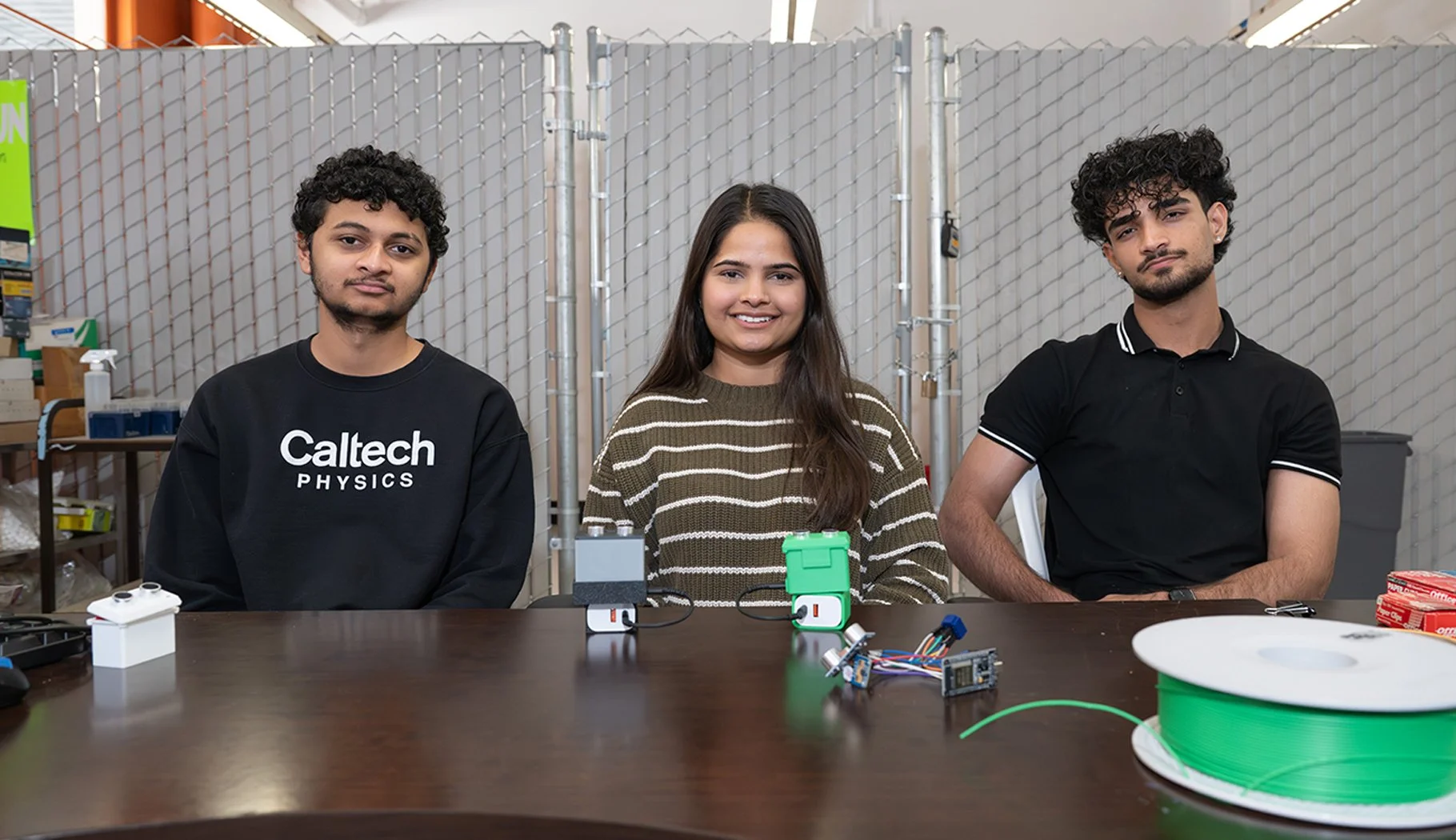
From Left to Right: Rohan Bhattarai, Bhakti Ahir Ahir, Ansh Tiwari. Credit: Lance Hayashida
The ongoing effort to retrofit the crucial fume hoods in Caltech labs is already reaping money and energy savings.
By Andrew Moseman
The fume hood is one of those essential but sometimes invisible parts of life in the lab, a high-powered portal that sucks air away from a workstation so that any possible contaminant is whisked away from humans and blown out of the building. In other words, these hoods work hard. But they do not always get their well-earned breaks.
There are around 700 fume hoods across Caltech, says Tasha Cammidge, the Institute’s Green Labs Coordinator. And though they do their jobs admirably, a single fume hood can use 3.5 times as much energy annually as a typical American house. Add to that the frequency with which these hoods are mistakenly left open when a researcher is done working and you have a significant opportunity to make labs more sustainable.
In 2024, Genevieve Gandara (BS ’25) was an intern with Caltech Green Labs when she began to ponder how to address that last issue. The fume hood problem was essentially twofold. First, these tools have to suck up air and pump it out of the building for safety’s sake. This requires far more energy than a home HVAC system, in which the same air ecirculates as it is being heated or cooled. Second, the hoods run continuously on high power until someone shuts them off. That is a good feature for a crucial piece of safety equipment, but it also means that if someone walks away and does not close the hood to reduce the airflow rate, it will just keep running at full power. Plus, open hoods pose a safety risk, as there is no physical barrier between the other occupants of the lab and the substances inside the hood. When people walk by, Cammidge says, this can trigger eddies in the airflow, which can cause the substances in the fume hood to waft out unintentionally.
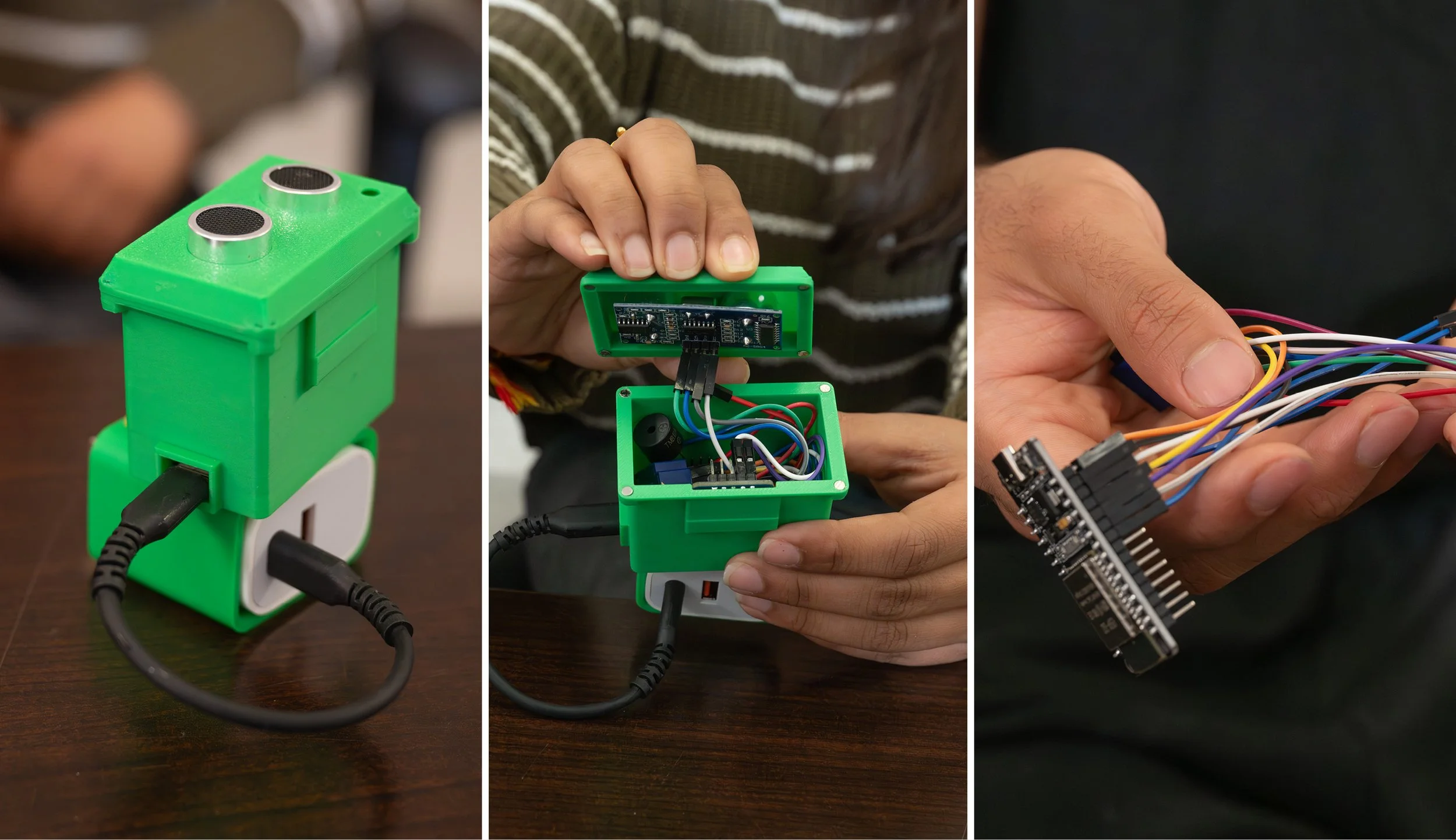
The Caltech students’ solution, which evolved out of an idea by a group of MIT researchers, was to install Motion and Sash Height (MASH) sensors that keep tabs on the sash height of the fume hood. If the hood has been left open and unattended for more than five minutes, an alarm notifies the user and encourages them to close the sash and lower the airflow. Cammidge says this simple student-built retrofit is vastly less expensive than buying new fume hoods that come with automatic sash closers, especially considering the Institute has hundreds of hoods that would need to be replaced or retrofitted with more expensive fixes than the student project.
Gandara installed 24 test versions of the sensors in the summer of 2024 and found that Caltech saved around $1,200 per hood over the course of a year. Not bad for a $15–20 solution that requires no more than a motion sensor, a circuit board, a distance sensor, some lights, and a buzzer. (The sensors are also encased in 3D-printed cases that are made at the TechHub.)
Credit: Lance Hayashida
Then, last year, undergraduate Bhakti Ahir Ahir decided to tweak the design again as part of her Summer Undergraduate Research Fellowships (SURF) program. She installed an additional eight sensors using her new design, which includes a smaller and less error-prone controller, an updated motion sensor, far less wiring, and other improvements. Cammidge says Caltech has since built 70 more of those sensors, with the goal of installing them this summer. Undergraduates Rohan Bhattarai and Ansh Tiwari joined the project in November 2025 and continue to refine the design and help with the rollout.
“I chose this project because it deals with energy conservation, which is a topic that may be often overlooked,” Ahir Ahir says. “It is fascinating to think a small, engineered device has the potential to save a substantial amount of energy and cost. I was drawn to it due to its problem‑solving nature, which forced me to hone and apply my engineering skills.”
Nearly 100 such devices are now planned for campus installation and will go through testing to work out any kinks. Afterward, the student researchers hope the finalized device can be rolled out to all 700 fume hoods at Caltech, Ahir Ahir says. “We are planning on installing them on the fume hoods in the Schlinger Laboratory for Chemistry and Chemical Engineering first, then installing them on the other fume hoods across various buildings on campus.”