
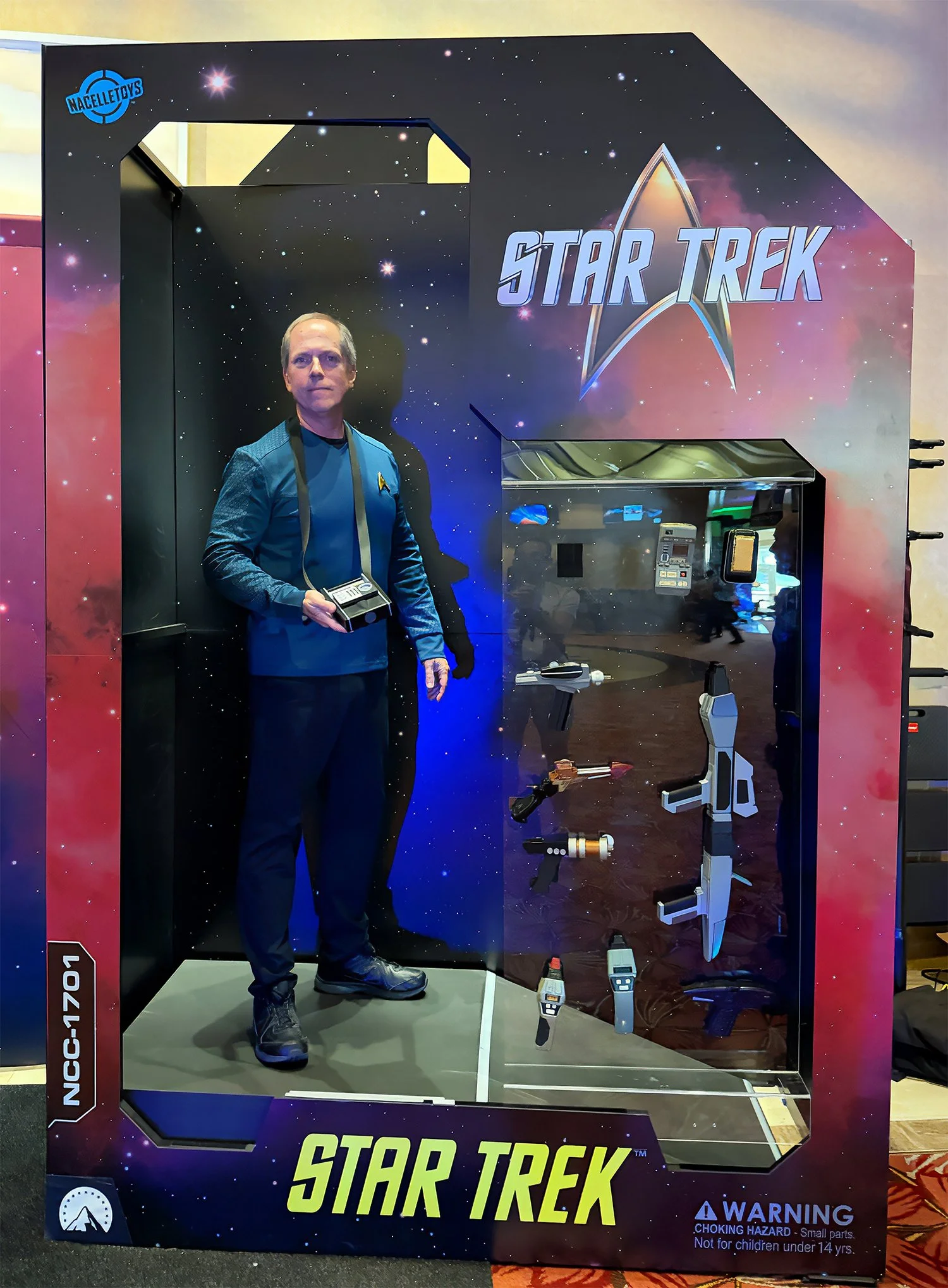
"Some of my earliest memories are sitting with my dad in the family room watching Star Trek during the original broadcasts on NBC. I was only 4 or 5, so I don't have much memory of it, but I grew up just knowing all the stories. Star Trek was literally my mythology as a child.
For me, Star Trek is about exploration—going into places we've never been. The fact that it placed such a central focus on the importance of science, by making the second-in-command of the Enterprise a science officer—who was also half-Vulcan, which meant logic prevailed—established in my mind that science is actually important. Science is the tool we use to understand the world around us. That naturally drove me into science, and it certainly generated my love of astronomy.
As a kid, the things that always resonated with me were the special effects—showing fantastical places we've never seen, worlds we could only imagine. We didn't even know if planets existed outside our solar system; that was a hotly debated topic even when I was in grad school. But it's that visual aspect of showing the unknown that had a deep influence on me, because I've always been very visual in how I understand ideas. I like diagrams, pictures, and I think through information visually. Shifting my career from astronomy into science visualization was very natural. I want a science visualization to be accurate and to clearly communicate a concept while also being beautiful, engaging, and cinematic."
September 8 marks the 60th anniversary of Star Trek, which premiered on NBC on September 8, 1966.
Robert Hurt is a visualization scientist at IPAC, a science and data center for astrophysics and planetary sciences at Caltech. He works with scientists to create data-driven visuals and has created art for many Caltech- and JPL-affiliated projects, including LIGO, NASA's Spitzer Space Telescope, NASA's Kepler mission, and more.
#SoCaltech is an occasional series celebrating the diverse individuals who give Caltech its spirit of excellence, ambition, and ingenuity. Know someone we should profile? Send nominations to magazine@caltech.edu.