
Pluto Lost Its Planethood 20 Years Ago. “Plutokiller” Mike Brown Explains the Ongoing Drama.
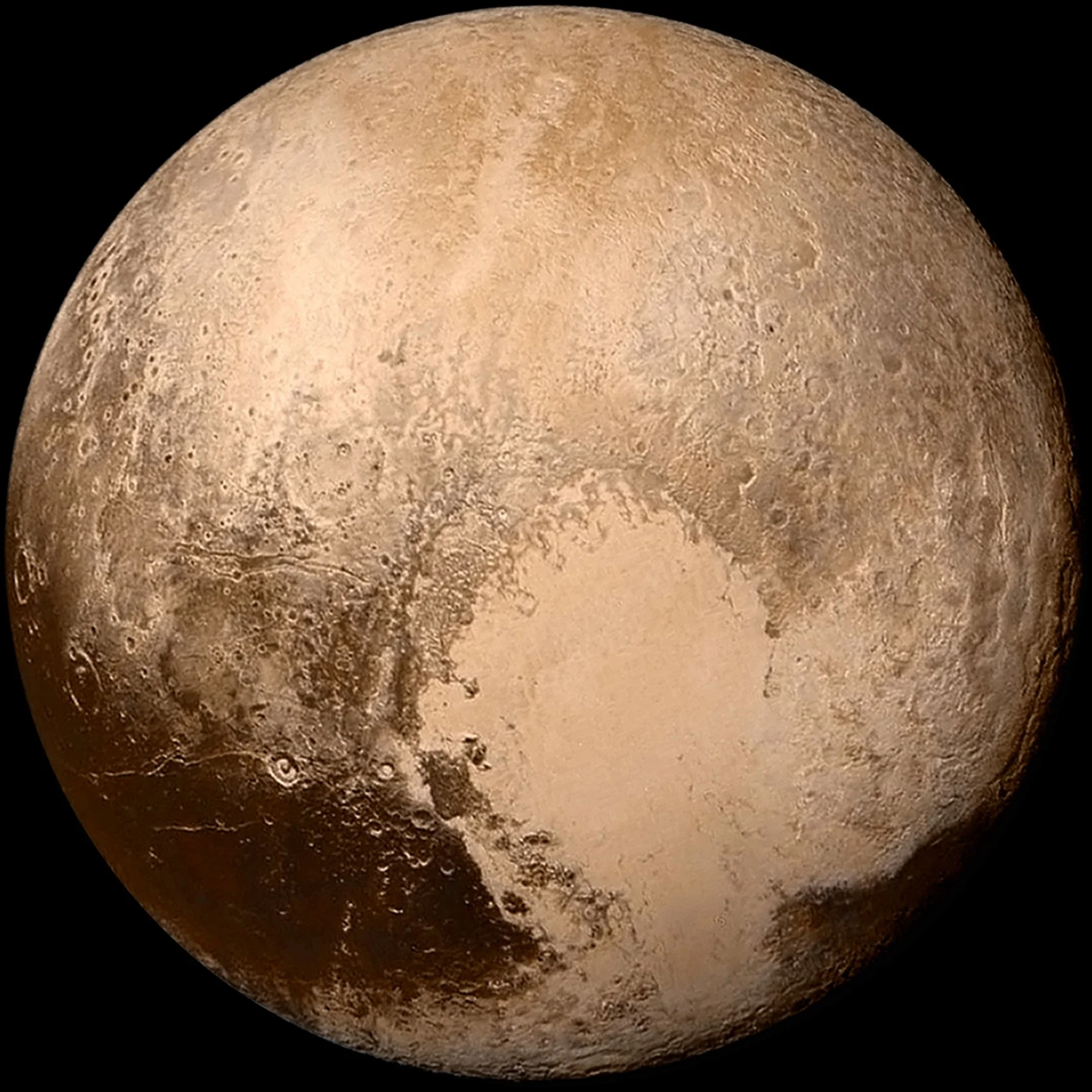
New Horizons image of Pluto. Credit: NASA / Johns Hopkins University Applied Physics Laboratory / Southwest Research Institute
The Caltech professor’s discoveries helped give Pluto a demotion. Two decades later, he still says Pluto had it coming.
by Andrew Moseman
On August 24, 2006, the International Astronomical Union formally reclassified Pluto—our solar system’s then-ninth planet—as a dwarf planet, reducing the planetary count to an even eight.
One of the key players behind that move was Caltech’s Mike Brown, now the Richard and Barbara Rosenberg Professor of Planetary Astronomy and the Terence D. Barr Leadership Chair and director of the Center for Comparative Planetary Evolution. In particular, Brown’s discovery of Eris, an object located near Pluto that is more massive than the former ninth planet, helped set in motion Pluto’s demotion. Despite some popular backlash, Brown would go on to write a book—How I Killed Pluto and Why It Had It Coming—and would adopt “Plutokiller” as his social media handle.
On the anniversary of Pluto’s planetary death this week, Brown authored a retrospective in Scientific American that revisits the questions about Pluto’s planethood, which continue to be debated two decades later. The logical case for the reclassification is as sound as ever, he argues: If Earth’s moon is not a planet, then Pluto isn’t one either. (Because the moon orbits Earth and not the Sun, it fails the first of three criteria for planethood. Pluto meets the first two qualifications: it orbits the sun and is round. But it fails the third because it hasn’t cleared its celestial “neighborhood,” meaning it is actually a dwarf planet.)
Much of the case to keep Pluto a planet, Brown writes, was propelled not by science but rather nostalgia. Though he notes that the emotion can be a powerful force indeed:
You might consider scientists immune to nostalgia, but they were children once, too—and some of them grew up in a solar system with nine planets, no less. A few of them then spent years of their lives studying Pluto—and even built and launched a spacecraft to go there, waiting a decade for its arrival and the spectacular images of that world’s nitrogen glaciers, suspiciously volcanolike mountains and bizarre system of moons. After all of this, having Pluto suddenly stripped of planetary status must feel like a betrayal. Even I feel it. I, too, had a solar system poster on my wall as a kid and stared at Pluto’s odd and distant orbit out on the edge. I could never imagine that someday there would be posters without it—or that I would help to make that happen.
Read Brown’s full column in Scientific American.