
Pasadena Math Pipeline: Local High School Students Join Caltech Math Courses
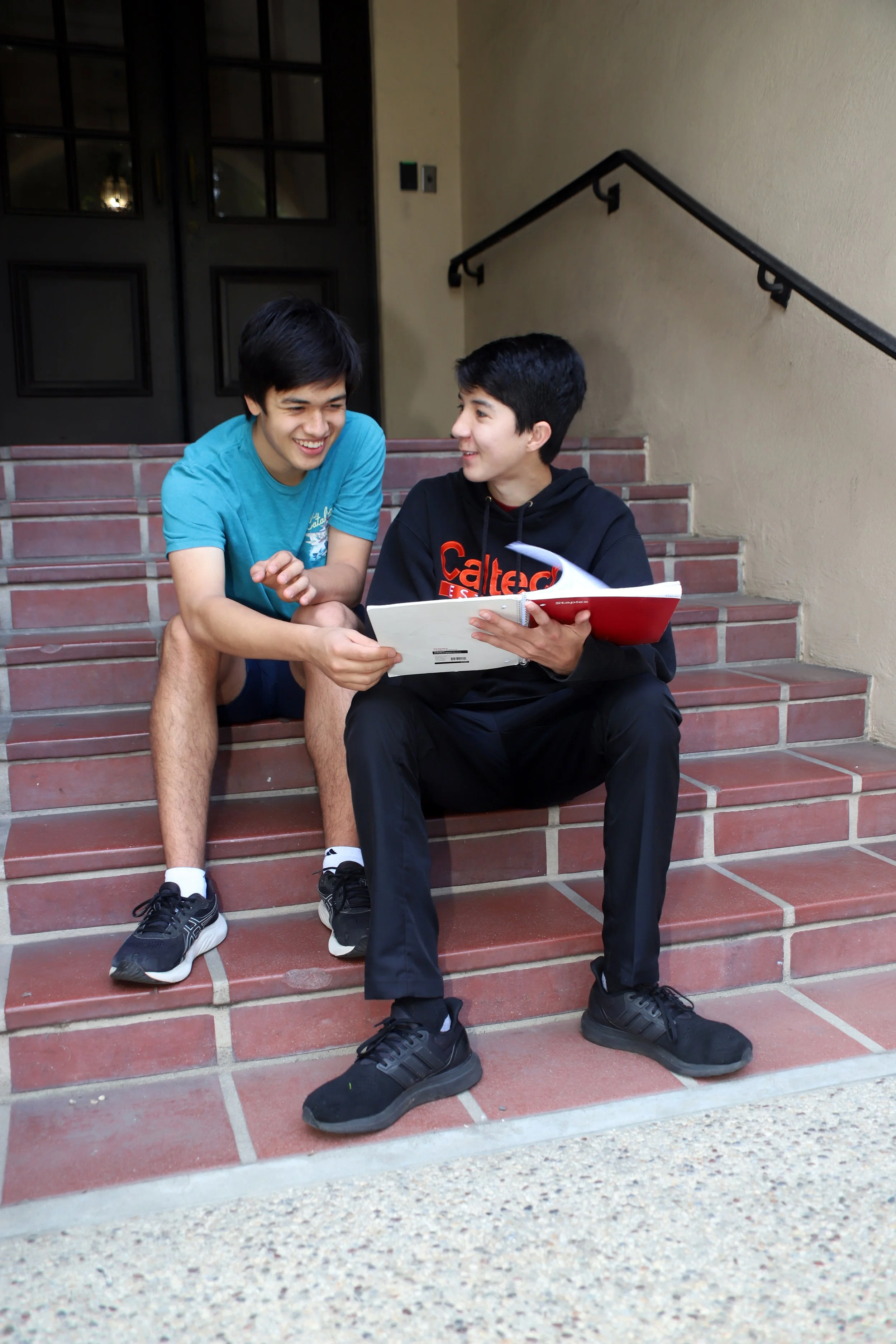
Pasadena High School students Jacob Monson (left) and Lucas Kittle at Caltech. Image: Caltech
by Ann Motrunich
Thanks to a recent partnership between the Pasadena Unified School District (PUSD) and Caltech, as many as five high school juniors and seniors in the district’s Math Academy now have the opportunity to join the Institute’s first-year math core courses (Math 1 a, b, and c) each year.
Omer Tamuz, professor of economics and mathematics, directs the dual-enrollment program for Caltech and says the program aligns with the Institute’s recruitment efforts. “I think there’s a general wish to expand Caltech’s relationship with local schools,” he explains. “We don’t want to miss out on exceptional local talent.”
Math Academy students, who can join the accelerated program as early as sixth grade, finish the high school advanced placement math curriculum in middle school and turn to proof-based college mathematics in ninth grade. “They are about four years ahead,” Tamuz says.
Lucas Kittle and Jacob Monson, a junior and senior at PHS, respectively, were the first students to simultaneously enroll at Caltech and PUSD under the new program, which launched in fall 2025. “Having this solid Caltech credit is going to be a big help when I apply to colleges, and I value the opportunity to learn what college classes are like,” Kittle says.
However, going from intimate Math Academy sessions to the Math 1 series at Caltech, which enrolls more than 100 students, was a major transition for the high schoolers. Monson values how teaching assistants personalize learning during recitation sections, and says he appreciates the depth of exploration. “Compared to Math Academy classes, Math 1 helps you dive deeper into each topic and see the root of how it’s built and how it connects to other topics.”
PUSD teacher Chris Anderson helped formulate the Caltech–PUSD program. “A lot of these students want to go to Caltech; it’s one of the schools on their list,” he says. “So, Caltech gets to see them, they get to see Caltech, and you can have a beautiful marriage of high-achieving student with high-achieving institution.”
The Math Academy, which was formally adopted into the PUSD curriculum in the 2016–17 school year, has seen two participants go on to become Caltech students before the launch of the dual-enrollment program: Justin Hong, now a second-year undergraduate studying computer science, and first-year graduate mathematics student Luisa Boateng. In addition, Math Academy alumnus Matteo Paz, now a research support technician at IPAC, a science and data center for astronomy at Caltech, won the 2025 Regeneron Talent Search for writing an AI algorithm that helped reveal 1.5 million celestial objects, research he conducted at the Institute.
Laureen-Nadirah Nayo, PUSD’s director for the joint program, selects dual-enrollment candidates from among the pool of students who have completed all the prerequisites. Students are recommended on the basis of their grades, focus, maturity, and work ethic. Caltech reviews the candidates proposed by Nayo. Selected participants provide their own transportation and fit the Caltech classes into their broader high school schedules. Though their enrollment is limited to the three first-year math classes, they have the same requirements and responsibilities as the Caltech students in those courses, and they receive a transcript upon completion for use in college applications. The high school students do not pay tuition fees.
“We are very excited about this collaboration with Caltech for our students,” Nayo says. “This opportunity directly addresses a need that they have expressed.”