
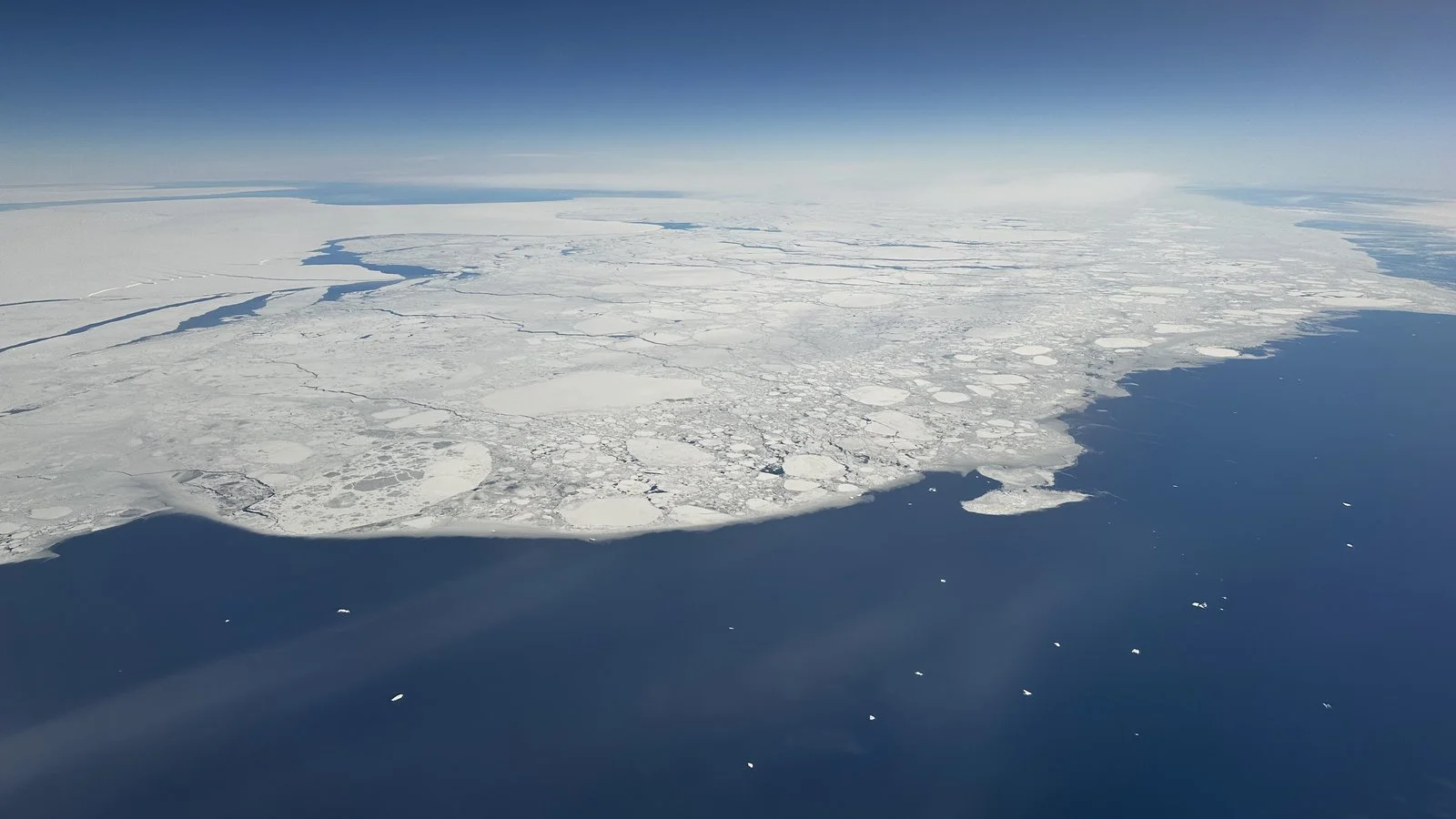
Credit: Caltech/GLASS Project
BY ANDREW MOSEMAN
One of Caltech’s most far-flung examples of field work is beginning to give us a better picture of how Antarctica’s ice sheets are changing, a phenomenon having an enormous impact on sea level rise. The video above takes you to the frozen continent to meet the researchers and see their methods.
The GLASS project (Grounding zone Long-term Acoustic Sensing of Structure) is supported by the Brinson Exploration Hub and co-led by Zhongwen Zhan (PhD ’14), professor of geophysics and the Clarence R. Allen Leadership Chair and director of Caltech’s Seismological Laboratory; and Joel Steinkraus, systems engineer in the Deployable and Precision Structures and Technology Group at the Jet Propulsion Laboratory, which Caltech manages for NASA. Work on campus is being conducted within the Resnick Sustainability Center.
A focus of Zhan’s research has been the use of existing fiber-optic cables, which were deployed for communications purposes, to monitor seismic activity and turn them into de facto earthquake detectors. To do so, scientists shoot beams of light down the cables, then measure seismic waves by observing how they cause the light to bounce to a receiver.
With GLASS, Zhan and Steinkraus have scaled up in ambition. The team has laid down cables on the Antarctic ice sheet, where they will be slowly buried by layers of snow and ice. The cables can then be used to measure the seismic activity created as the glaciers creep. Zhan and colleagues are particularly interested in using this method to measure the grounding zone, or the place where the bottom of a glacier goes from resting on rock to floating on water.
The Brinson Exploration Hub brings together teams from Caltech and JPL to pursue boundary-pushing science, enabling them to move ambitious ideas from concept to real-world deployment on accelerated timelines. GLASS is one example—advancing from initial concept to Antarctic field deployment in under a year. The Brinson Hub is focused on enabling this kind of science more broadly: supporting efforts that deepen our understanding of Earth and the universe while embracing speed, risk tolerance, and close integration between science and engineering teams.
To learn more about the GLASS field experiment in Antarctica, visit the team’s Field Notes website for day-to-day updates.