
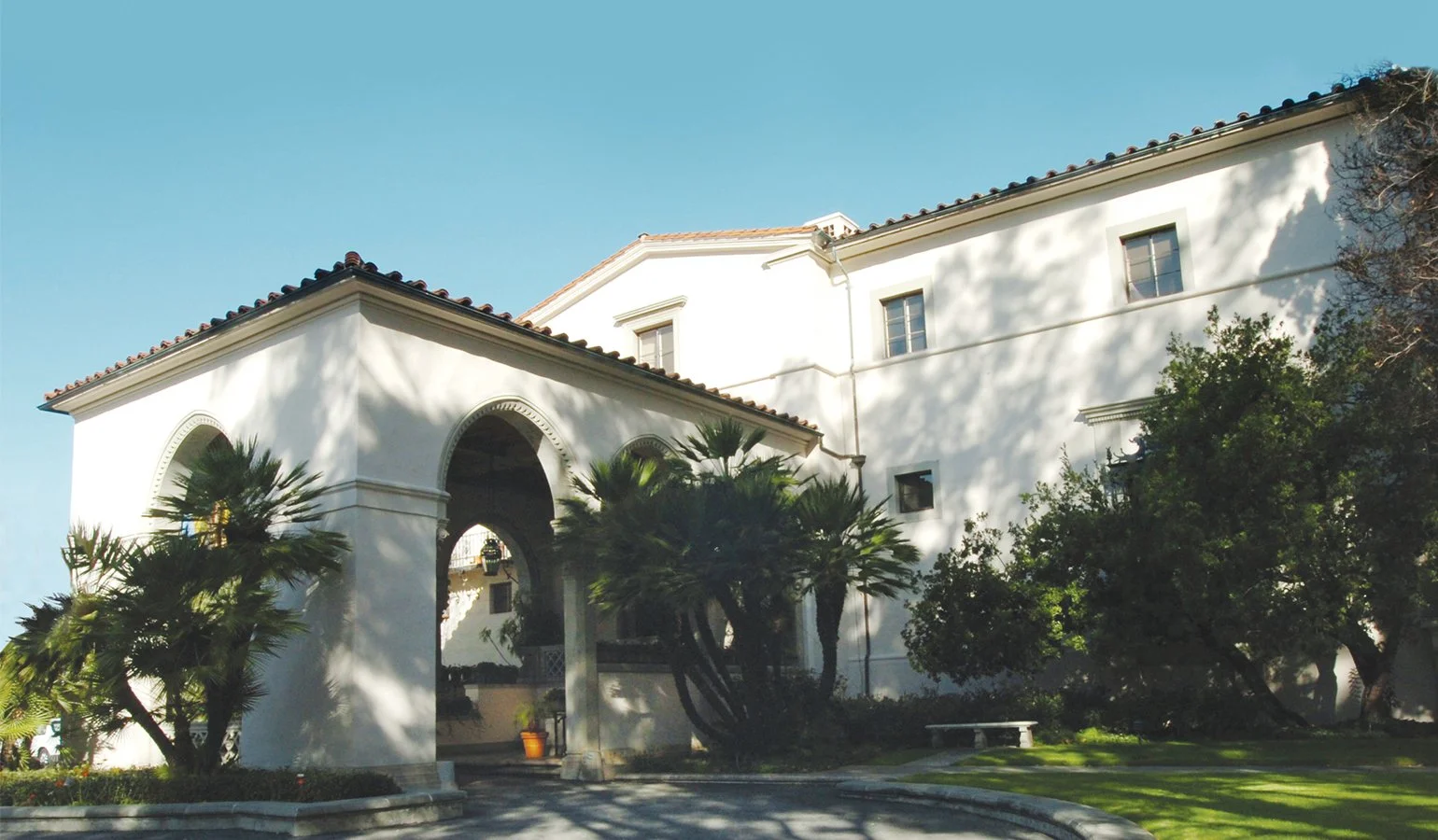
The Caltech Athenaeum. Credit: Caltech Archives
By Omar Shamout
On March 9, 1926, retired railroad magnate and art collector Henry E. Huntington invited 100 of Southern California’s most influential men and women to his home in San Marino. Although he had hosted many gatherings of the area’s social and business leaders, this one would prove to be historically significant for a nearby institution—and the world.
Around that same time, the Caltech Board of Trustees had recognized the need to raise flexible funds to aid and advance the recently renamed California Institute of Technology’s welfare by forming a new organization: the Associates of the California Institute of Technology. Trustees Allan Balch, Henry O’Melveny, Norman Bridge, and Henry Robinson pledged to promote the group. When 100 donors had agreed to contribute $1,000 per year for 10 years to the Institute, Huntington held the Associates’ first formal meeting at his home.
“The Caltech we know today exists because a prescient group of leaders came together to provide our academic community with the resources to not only endure but to thrive,” says Caltech President Thomas F. Rosenbaum, the Sonja and William Davidow Presidential Chair and professor of physics.
In the years following the group’s founding, the Caltech Associates would have an outsized impact on Caltech’s campus in terms of its physical footprint but also in the kinds of research being performed at the Institute, thereby growing Caltech’s societal reach. As recounted in The Associates of the California Institute of Technology: Patrons of the Century’s Science, Caltech’s campus comprised just five buildings in 1926, and the Institute only offered courses in engineering, chemistry, and physics. Associates William G. Kerckhoff and his wife, Louisa Eshman Kerckhoff, funded a biology laboratory, and Thomas Hunt Morgan came from Columbia University to launch the new department. A few years later, Morgan became Caltech’s second Nobel laureate.
The Division of the Humanities, now the Division of the Humanities and Social Sciences, was formed in 1926 and endowed by eight Associates. The division was then housed in a building funded in 1927 by Joseph B. Dabney and his wife, Louise E. Dabney. In the late 1920s, construction began on the world-renowned Palomar Observatory, a dream of Caltech Trustee and Associate George Ellery Hale, who secured funds from the Rockefeller Foundation to build the facility’s 200-inch telescope near San Diego.
Today’s housing system, a staple of undergraduate life at Caltech, had its start in the 1930s, when Associates members, believing small residences were best for students, donated funds to build the South Houses. Noted Southern California architect Gordon Kaufmann designed the South Houses, as well as the Athenaeum, which opened in 1930 thanks to a gift from Balch and his wife, Janet Jacks.
Today, the Associates’ membership has grown to more than 1,000 households. Over the past century, Associates have given more than $73 million in unrestricted annual membership gifts and more than $2.5 billion to the Institute to support facilities, research, faculty, and students.
To acknowledge that support and move the Associates into its second century of impact, the group has created the Associates 100 Legacy Circle, which will comprise 100 individuals or households, each making an unrestricted commitment of $150,000 over the next 10 years. (This amount was chosen to provide approximately the same purchasing power as the original 1926 gifts, adjusted for inflation.)
“Now, we have the opportunity to prepare the way for future generations of scholars to build on this legacy and seed new discoveries in fearless fashion,” Rosenbaum says. He and his wife, Katherine T. Faber, the Simon Ramo Professor of Materials Science, were among the first to join the Associates 100 Legacy Circle. Each member will be acknowledged at events during the group’s centennial year and will be commemorated on a donor wall.
This flexible funding will be used to advance Caltech’s highest priorities: attracting and retaining the most creative, insightful, and ambitious faculty and students; providing access to the newest instruments and facilities to accelerate innovative and impactful research; and bolstering Caltech’s scientific leadership on the global stage.
“The founders of the Caltech Associates had the vision to give the Institute an extraordinary unrestricted gift,” says Tracy Fu (BS ’92), the 52nd president of the Caltech Associates Board. Fu and his wife, Sharon Wee, are also early members of the Associates 100 Legacy Circle. “I am sure they would be astounded by what Caltech has accomplished in the last 100 years and would feel great pride in their foresight. My imagination is inadequate to foresee what will happen at Caltech over the next 100 years, but I am certain that it will change the world for the better.”
For more information on the Caltech Associates, visit: https://associates.caltech.edu/.