
The Explorer Class: Dimitri Mawet on Building the Planet-Finding Tech of the Future
The Explorer Class introduces the extraordinary people who make possible some of NASA's, and humanity's, most ambitious and technically demanding missions. Caltech astronomer Dimitri Mawet reflects on how JPL helped turn his unconventional idea into a technology that could potentially one day image another Earth.
This series of profiles highlights scientists, engineers, and innovators who have made Caltech JPL a center of American excellence.
by Lori Dajose (BS ’15)
In 2005, Dimitri Mawet was a graduate student with a developing idea: A new way to take pictures of exoplanets, worlds far outside our own solar system. But he was told his concept was impossible.
"A well-known optics professor in Paris told me, 'You'll never be able to make this; it is too difficult,'" he says.
Undeterred, Mawet finished his graduate studies and took his idea to a place where engineers can do the impossible: Caltech's Jet Propulsion Laboratory (JPL).
Taking images of exoplanets is like trying to take a picture from thousands of miles away of a firefly next to a spotlight. Techniques to directly image exoplanets must use a device called a coronagraph to block out light from a host star, allowing the faint beams from the planet to be captured. Historically, direct imaging has been limited mainly to young, self-luminous giant planets on relatively wide orbits. But what if we could take photos of Earth-like planets—small, with milder temperatures, and located close to their stars? And what if, through those photos, we could search for alien life?
As a graduate student, Mawet, who is now the David Morrisroe Professor of Astronomy at Caltech and a senior research scientist at JPL, which Caltech manages for NASA, had a concept to create a new type of coronagraph called an optical vortex that could potentially image earthlike planets.
Traditional coronagraphs work by putting a physical "mask" on the focus point of a lens to blot out a star's light, allowing the fainter things around it to become visible. But the technology only sees planets if they if they are located a certain angle away from their star. Someone on a faraway planet looking at our own solar system with a traditional coronagraph would not be able to see Earth, for example.
The optical vortex coronagraph uses a different type of mask.
"Instead of a physical mask, we create an 'optical vortex' that expels the star's light from the instrument," he explains. "These can be made from liquid-crystal polymers, similar to your smartphone's display. Except here, the molecules are frozen into orientations that force light waves passing through the center of the mask to become canceled out. If we point the telescope so the star's image lands exactly on the vortex, its light will be filtered out, but any light that's not perfectly centered on the vortex—such as light from the planets, or from a dust disk around the star—will be slightly off-axis and will go on through to the detector."
After finishing his graduate work, Mawet started a postdoctoral appointment at JPL and began to build a prototype of the vortex coronagraph. The very first prototype, a thin layer of liquid polymer sandwiched between a square inch of glass, was a disaster.
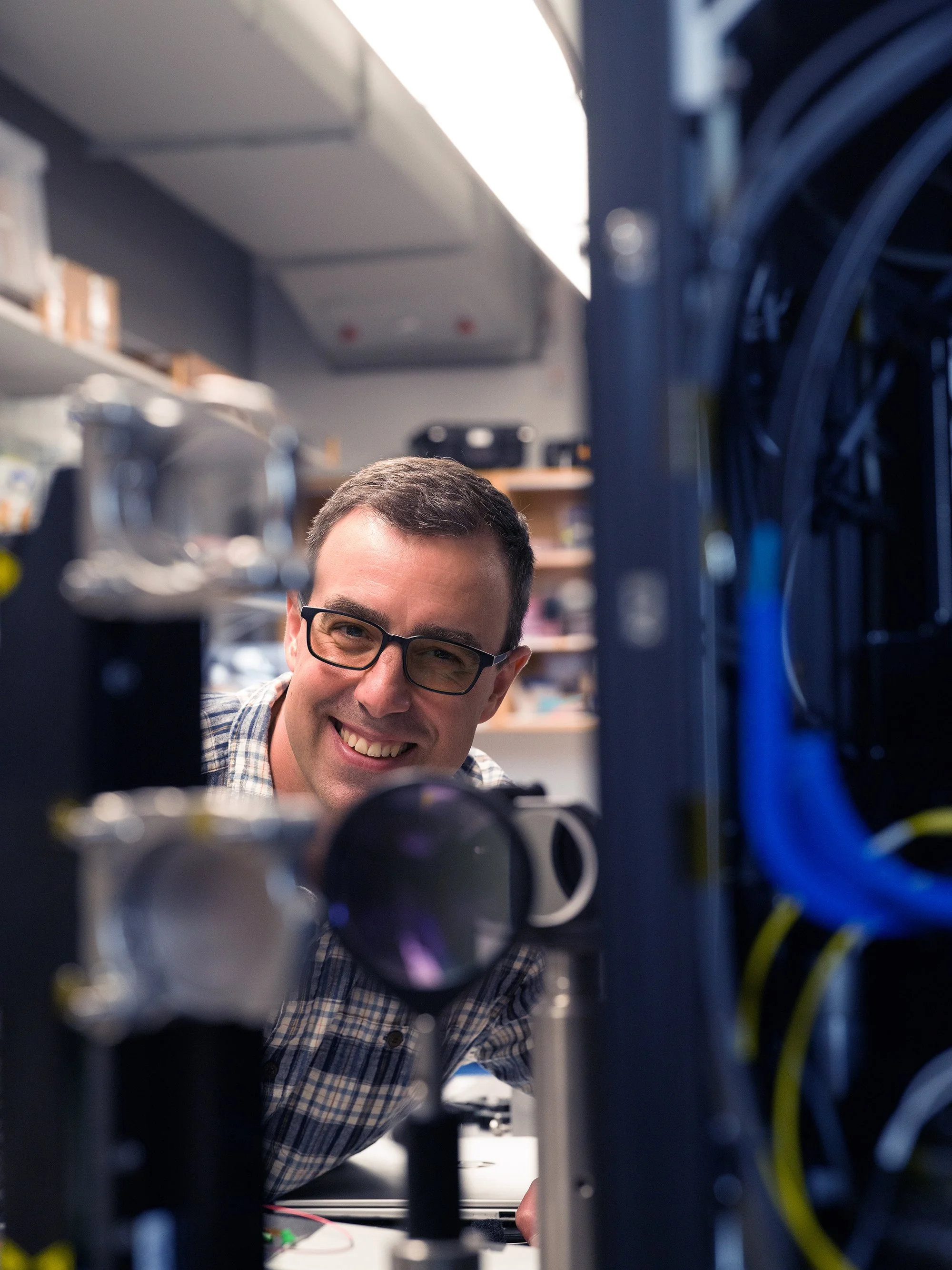
Credit: David Levine
“We tried to understand why it didn’t perform well and identified the shortcomings and defects, developed workarounds. The second generation was already 100 times better. It’s so satisfying to fail, understand why, and then try again.”
After a few years of iteration, Mawet and his collaborators took their improved coronagraph prototype to the Palomar Observatory, operated by Caltech, a few hours south of Pasadena in San Diego County's Palomar Mountains, and fitted it onto the 200-inch Hale telescope. The instrument obtained new images of HR 8799—the first-ever directly imaged multiplanet system, in 2008. The system detected the innermost planet only two diffraction beamwidths from its star, demonstrating that a vortex could work at angular separations far smaller than were routinely accessible at the time.
In 2015, Mawet joined the Caltech faculty as an associate professor of astronomy, and JPL as a research scientist; he became a full professor in 2019 and Morrisroe Professor and a JPL senior research scientist in 2022.
Over the years, Mawet has continued to improve his vortex coronagraph techniques; he has devised other instruments and methods to improve the stability and optics quality of telescopes, like wavefront control techniques that correct for thermal disturbances produced by telescopes themselves. However, directly imaging a twin Earth planet—where life as we know it is most likely to flourish—will take a massive refinement of current technologies. Planets like Earth that orbit Sun-like stars in the so-called "Goldilocks"—or habitable—zone are easily lost in the glare of their stars. Our own Sun, for example, outshines the light of Earth by 10 billion times. For a coronagraph to achieve this level of starlight suppression, researchers will have to push their technologies to the limit.
In August, NASA's Nancy Grace Roman Space Telescope launched into space, carrying a coronagraph technology demonstration designed and built at JPL—the first active coronagraph to fly in space. The first of its kind, the Roman Coronagraph Instrument is a technology demonstration that will enable astronomers to image exoplanets possibly up to a billion times fainter than their stars.
The Roman Coronagraph Instrument is a key step on what Mawet calls a "roadmap" to one day directly imaging and characterizing an Earthlike planet. The mission is a precursor to NASA's Habitable Worlds Observatory (HWO), a flagship mission now in development and with a proposed launch in the 2040s, that will look for potential signatures of life—liquid water, carbon dioxide, and oxygen—on Earthlike planets.
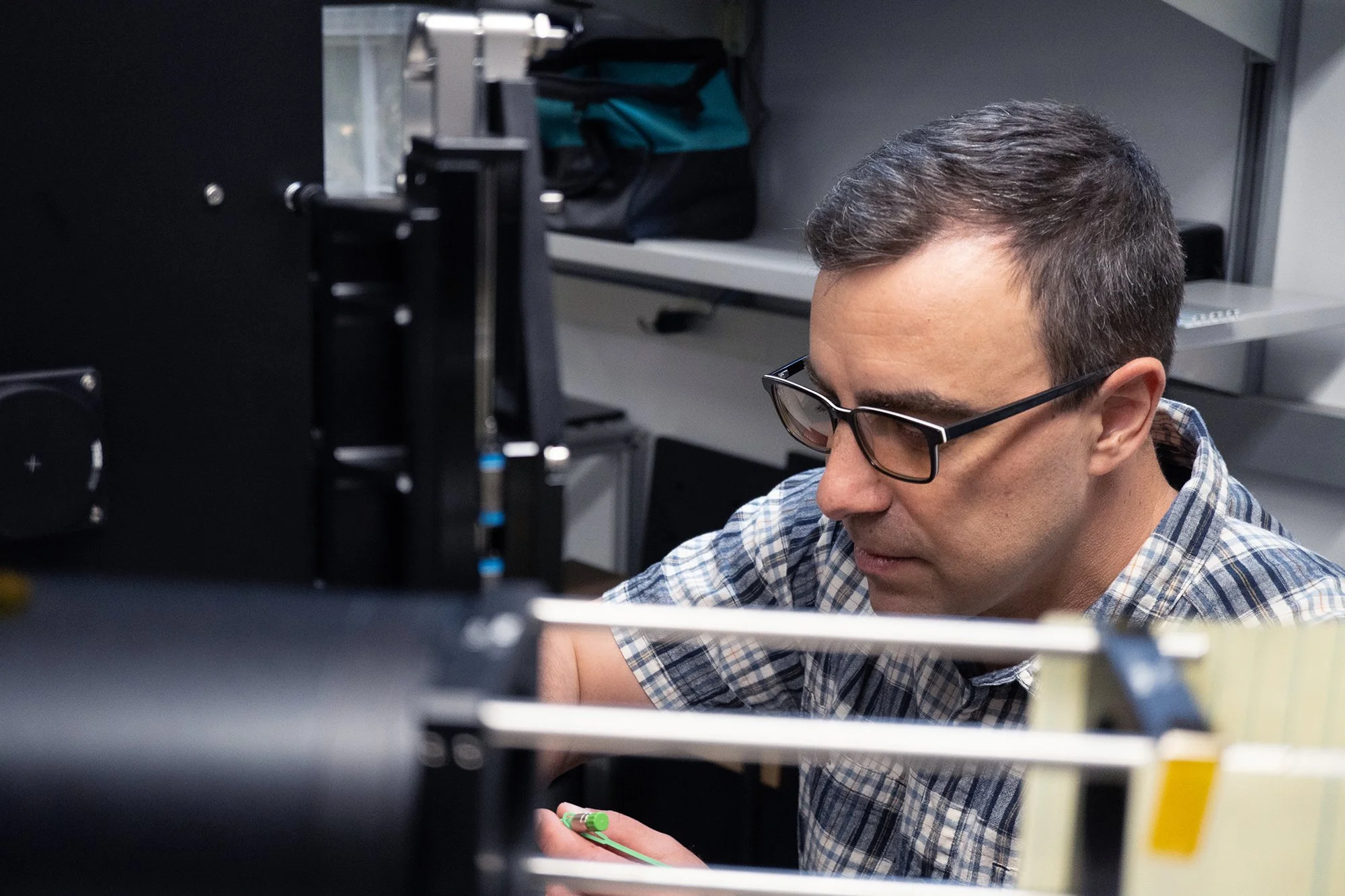
Credit: David Levine
Mawet is proposing that HWO carry an optical vortex coronagraph.
For Mawet, the progression of the vortex coronagraph illustrates what makes the Caltech–JPL environment unusual. On the Caltech campus, new ideas in optics and astrophysics can be developed alongside the scientists who will ultimately use them. At JPL, those concepts can be turned into precision hardware, tested on some of the world's most advanced high-contrast imaging testbeds, and matured with the engineering discipline required for spaceflight. Palomar and Keck then provide a way to test emerging technologies rapidly on real stars and planets before lessons from the sky are fed back into the laboratory and into future space missions.
“Very few places connect fundamental optics, astronomical instrumentation, exoplanet science, and spaceflight engineering this tightly,” Mawet says. “You can close the loop from an idea on paper, to a laboratory prototype, to a telescope on the sky, and ultimately to space.”
In 2025, Mawet became the director of instrumentation at Caltech's Optical Observatories, which administers Palomar Observatory and supports the Keck Observatory
At Caltech, Mawet also directs the Exoplanet Technology Laboratory, which develops new instruments and observing techniques for facilities including Palomar and Keck. One example is the Keck Planet Imager and Characterizer, or KPIC, which operated from 2018 through 2025. KPIC coupled the Keck II adaptive-optics system to a high-resolution spectrograph using single-mode optical fibers, allowing astronomers to isolate the faint light of directly imaged planets and measure molecules in their atmospheres, their motion along their orbits, and even how rapidly they spin.
KPIC was designed as a pathfinder. The technologies it demonstrated are now being carried forward into a new generation of instruments, including HISPEC at Keck and ultimately systems designed for future extremely large telescopes—another step along the road toward studying smaller, colder worlds and, eventually, planets like Earth.