
A Planet's Oeuvre: How Mars Symphony Melds Music and Science

Credit: Raja Palanimurugan
by Sharon W. Tran
“Welcome to Mars.” This is how David Ibbett, composer of Mars Symphony, introduces his piece to the audience. And when he tells them that all the sounds they are about to experience were recorded from the surface of the Red Planet, he feels a chill run down his spine as he watches the awe on their faces.
Produced in collaboration with the Museum of Science in Boston, Ibbett’s Mars Symphony is an audiovisual experience that weaves real sounds and images from our planetary neighbor with a data-driven musical composition performed by a live ensemble. The project draws on research done at the Jet Propulsion Laboratory (JPL), which is managed by Caltech for NASA; Worcester Polytechnic Institute (WPI); the Center for Astrophysics | Harvard & Smithsonian; and ETH Zurich. Mars Symphony will be performed at Caltech’s Beckman Auditorium on Thursday, October 30, at 7:30 p.m.
Ibbett currently serves as an assistant teaching professor at WPI in Worcester, Massachusetts, and he is also the project director of the Multiverse Concert Series and resident composer at the Center for Astrophysics | Harvard & Smithsonian. When he started composing music for Mars Symphony, he imagined the performance as an arc that would trace the past and present of Mars and the future of solar-system exploration. Ibbett completed the initial movements of Mars Symphony, which detail the planet’s history of drying oceans and erupting volcanoes, in collaboration with the Firebird Pops Orchestra in Boston. In 2022, when it came time to compose the movements about Mars in our current age, Ibbett wanted to tell the story of the rock samples from the Perseverance rover, which led him to JPL.
Through a chain of emails, Ibbett’s outreach eventually reached the inbox of Katie Stack Morgan, who was then the deputy project scientist of the Mars 2020 Perseverance rover mission. She currently serves as the mission’s project scientist. In 2022, one of her primary duties was to field requests for potential collaborations with the Perseverance science team.
“I’d never heard of anything like this project,” Stack Morgan says. “When it became clear that David intended to turn texture and color from Perseverance image observations into sound, I began to wonder if our samples were going to be musically beautiful or hard on the ears. It was something we wouldn’t normally think about as scientists, so it was really neat to consider.”
Over the course of two years, Stack Morgan introduced Ibbett to colleagues who could assist with his endeavor. One was Justin Maki, a JPL imaging scientist and systems engineer who soon found himself using his technical knowledge in image processing to help Ibbett translate image data into music through a process called sonification. When Maki and Ibbett first met at JPL in April 2024, Ibbett ran Maki’s pictures of core samples of the Martian surface, taken by Perseverance, through a digital program that mapped the different features of the sample to specific sounds.
“With the samples, I play them like a record,” Ibbett says. “You have this circular sample core, and we turn that into a musical score as it rotates. As the needle moves, we pass over the different grains: A dark obsidian might be a strong brass note, or a sedimentary rock that’s looser might be strings and winds.”
Ibbett’s final composition represents other aspects of Mars as well. An electric guitar evokes the “grimy ruggedness” of the terrain, a flute signals the presence of Mars’s past oceans, and a voice emerges as the voice of the universe.

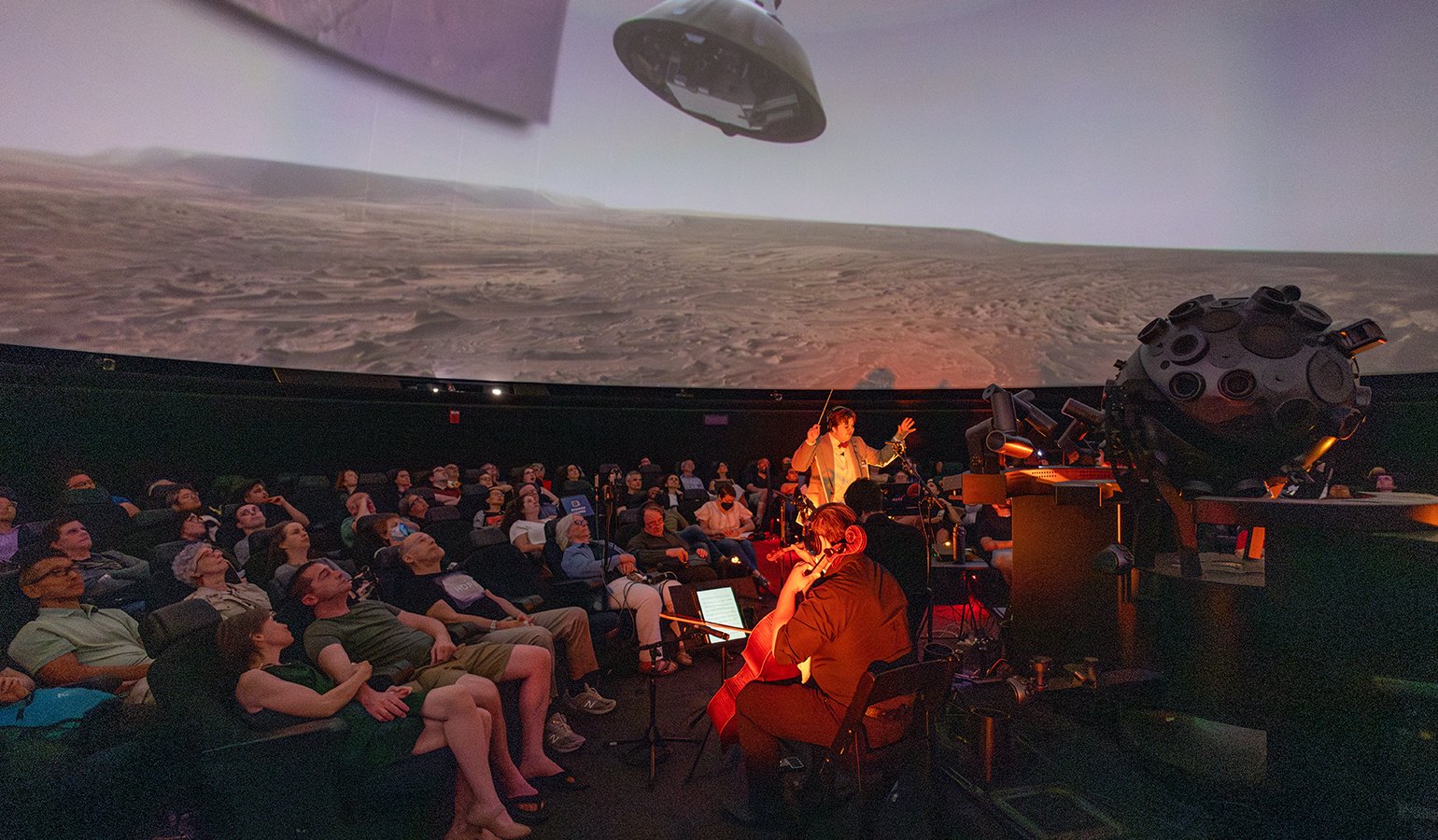
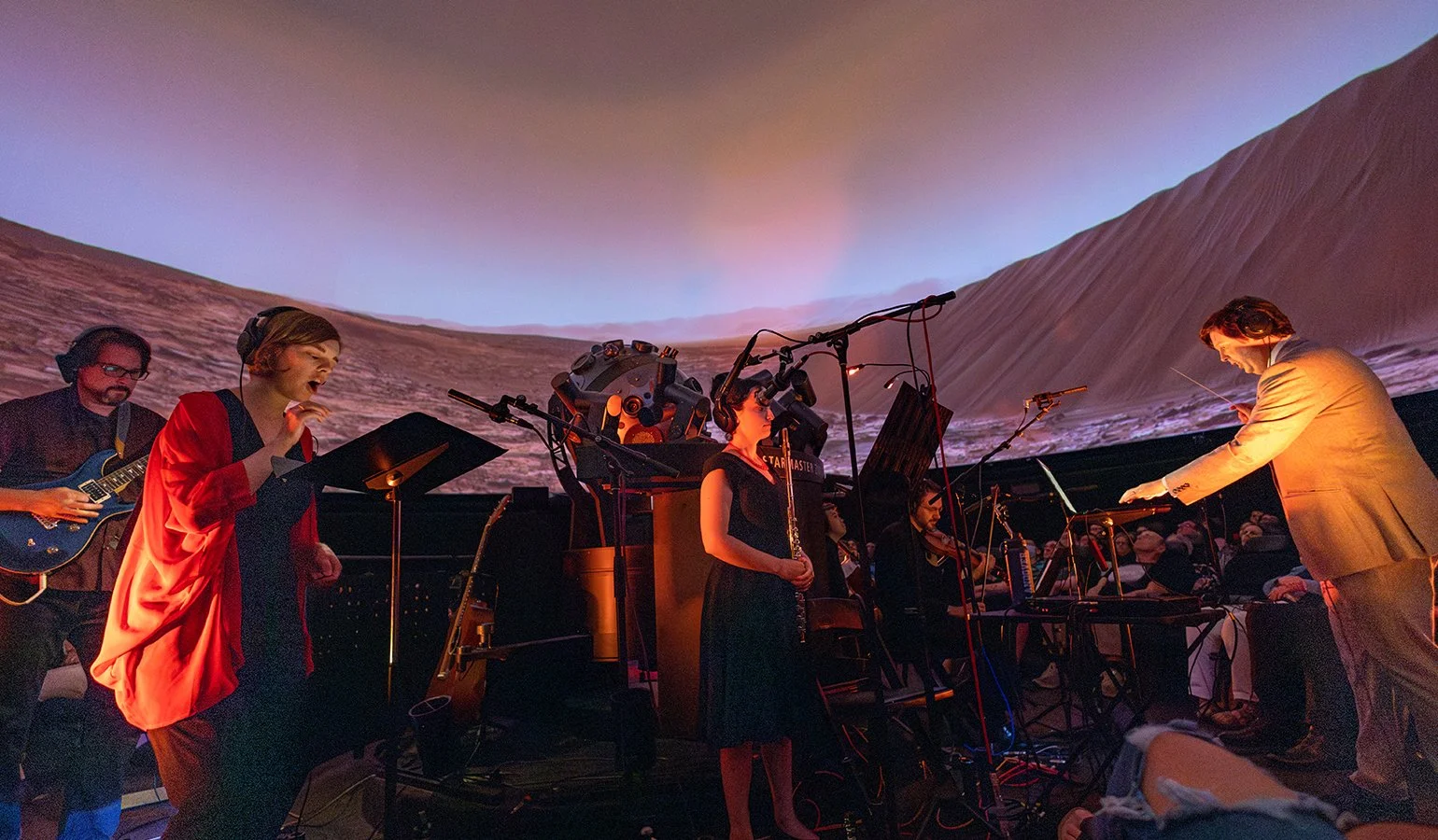
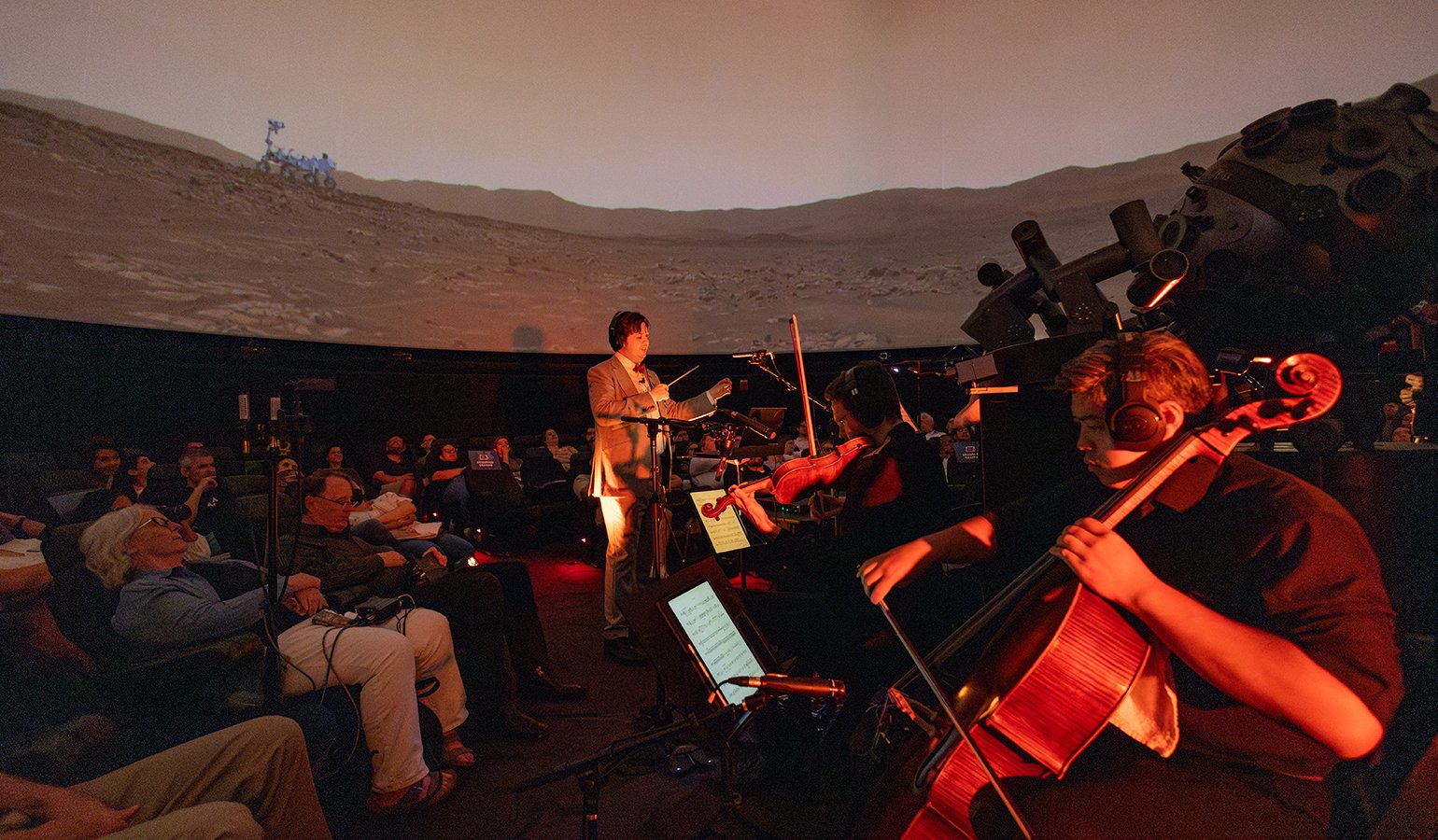
"I think that the emotion we’re always trying to inspire is awe and wonder, because I think that’s the gateway to so many other activities,” Ibbett says. “It provokes curiosity, and it drives people to develop their own passion for space and for music if they become awestruck by the planet, or by the amazing technology that we’ve sent to it, or by the history of the solar system.”
Maki, who attended Mars Symphony’s premiere performance at the Charles Hayden Planetarium in Boston in the summer of 2024, says he experienced a form of wonder that was reminiscent of something close to home.
“We have a large panoramic image of Mars in the hallway outside of our offices that’s 30 feet long,” Maki says. “It’s a spectacular view of the rim of Jezero Crater, showing the route that the rover drove up and out of the crater over the course of a year. Sometimes, between operations shifts, we take a moment to admire the view. Listening to the music was similar; It’s like admiring the view.”
Tickets for Mars Symphony’s one-night-only performance at Caltech’s Beckman Auditorium are free, but seating is limited. You can reserve your seats for the October 30, 2025, event through Caltech Public Events.